Amelogenesis Imperfecta
Question Write note on amelogenesis imperfecta.
Answer. Amelogenesis imperfecta is also known as hereditary enamel dysplasia or hereditary brown enamel.
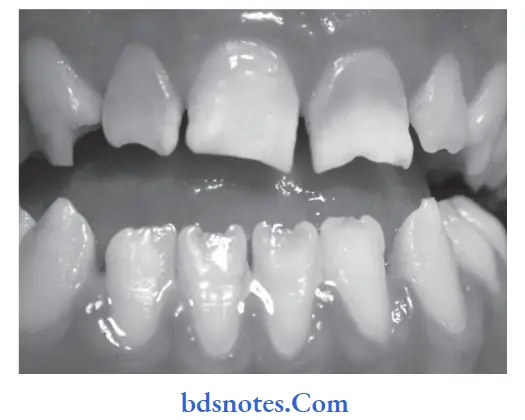
“Understanding the role of amelogenesis imperfecta in dental health: Q&A explained”
- Amelogenesis imperfecta is a heterogeneous group of hereditary disorders of enamel formation affcting both deciduous or permanent teeth.
- Disease involves only the ectodermal part of the tooth, i.e. enamel.
- It is of three types:
1. Hypoplastic type
2. Hypocalcifid type
3. Hypomature type
1. Hypoplastic type: In this the enamel thickness is usually far below the normal since disease affects the stage of matrix formation.
In this stage the teeth exhibit complete absence of enamel from crown surface or there may be a very thin layer of enamel in some focal areas.
“Importance of studying amelogenesis imperfecta for better diagnostic outcomes: Questions explained”
2. Hypocalcifiation type: This is due to disturbance in the process of early mineralization of enamel.
In this stage the enamel is soft and can easily be removed with blunt instrument.
3. Hypomaturation type: This occurs due to interruption in the process of maturation of enamel. Here the enamel is of normal thickness but it does not have normal hardness and is translucent. The enamel can be pierced with an explorer tip with fim pressure.
“Steps to explain the causes of amelogenesis imperfecta: Genetic mutations vs environmental factors: Q&A guide”
Clinical Features
- Color of teeth is mostly chalky white but sometimes it can be yellow or even dark brown.
- Contact points in proximal surfaces are mostly open while the occlusal surfaces and incisal edges are severely abraded.
- Enamel may have a cheesy consistency which is easily removable from tooth surface.
- Amelogenesis imperfecta does not increase the susceptibility of teeth to dental caries.
- In amelogenesis imperfecta the enamel is of near normal hardness and has some white opaque flcks at incisal areas of teeth. These types of teeth are known as snow-capped teeth.
“Common challenges in diagnosing amelogenesis imperfecta effectively: FAQs provided”
Treatment
There is no definite treatment of amelogenesis imperfecta.
Composite veneering can be done to improve esthetics of teeth.
Leave a Reply