Beta Oxidation Of Palmitic Acid
Describe beta oxidation of palmitic acid. Add a note on its energetics.
Answer.
Beta Oxidation Definition
- In beta oxidation the fatty acids are oxidised by the removal of 2 carbon atoms at a time.
- The carbon atom in the beta position is attacked first; hence it is called beta oxidation
Tissues In Which Beta Oxidation Is Carried Out
- Beta oxidation takes place in the liver, heart, kidney, testes and adipose tissue.
- In cardiac muscle, 80 % of the energy is derived from beta oxidation
Beta Oxidation of Palmitic Acid: Steps and Pathway
Site Of Beta Oxidation In The Cell
Beta oxidation takes place in the mitochondria
Activation Of Fatty Acids
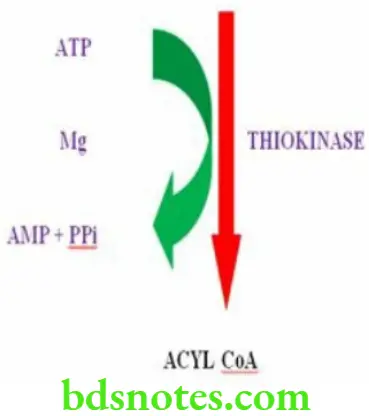
- Fatty acids are activated to acyl CoA by the enzyme thiokinase.
- Two ATP’s are required for the activation of fatty acids.
Role Of Carnitine
- Acyl CoA is formed in the cytosol whereas beta oxidation takes place in the mitochondrial matrix.
- Acyl CoA cannot penetrate the mitochondrial membrane on its own.
- Acyl CoA can penetrate the mitochondrial membrane only in combination with carnitine.
- Carnitine is present in high concentration in the liver and muscles.
- The normal blood level of carnitine is 7 to 14 micrograms %.
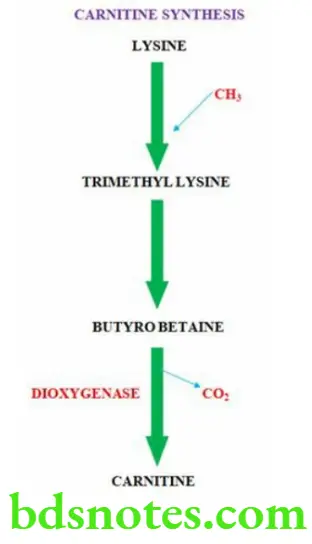
- Carnitine is synthesised in the liver and kidneys from lysine and methionine.
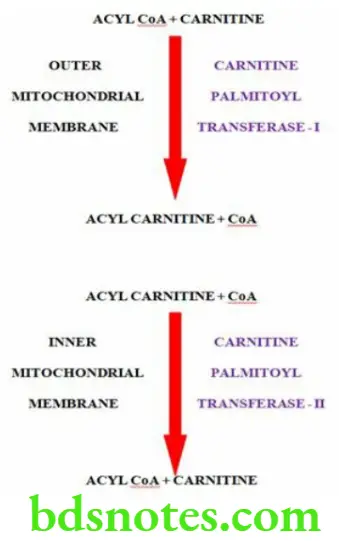
- Carnitine acts as a carrier molecule or ferry boat and transports acyl CoA across the mitochondrial membrane.
- The enzymes required are carnitine palmitoyl transferase 1 and 2.
Palmitic Acid Beta Oxidation: Mechanism and Enzymes Involved
Role Of Carnitine
- Acyl CoA is formed in the cytosol whereas beta oxidation takes place in the mitochondrial matrix.
- Acyl CoA cannot penetrate the mitochondrial membrane on its own.
- Acyl CoA can penetrate the mitochondrial membrane only in combination with carnitine.
- Carnitine is present in high concentration in the liver and muscles.
- The normal blood level of carnitine is 7 to 14 micrograms %.
- Carnitine is synthesised in the liver and kidneys from lysine and methionine.
- Carnitine acts as a carrier molecule or ferry boat and transports acyl CoA across the mitochondrial membrane.
- The enzymes required are carnitine palmitoyl transferase 1 and 2.
Reactions Of Beta Oxidation
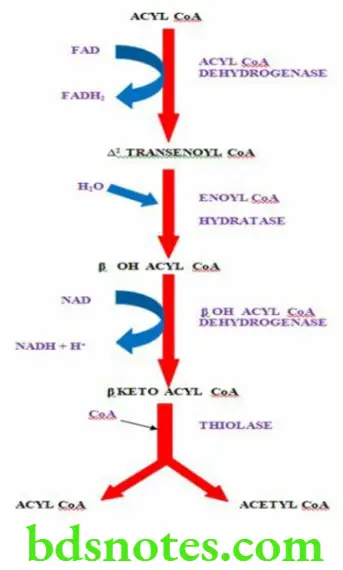
- The end products of beta oxidation are acyl CoA and acetyl CoA.
- The acyl CoA enters beta oxidation cycle again and the acetyl CoA enters the Krebs cycle where it oxidised to carbon dioxide and water.
Energy Yield from Beta Oxidation of Palmitic Acid
Beta Oxidation
Palmitic Acid Is C15H31COOH.
- Hence for complete beta oxidation it has to undergo 7 cycles producing 7 acetyl CoA.
- One acetyl CoA is produced extra in the last cycle.
- Hence the total acetyl CoA produced by beta oxidation of palmitic acid is 8.
Beta Oxidation Pathway of Palmitic Acid: From Activation to Cleavage
Energetics Of Beta Oxidation
- 4 ATP’s are generated in each cycle of beta oxidation – 2.5 from NADH and 1.5 from FADH2.
- Hence 7 cycles will generate 28 ATP’s.
- 8 acetyl CoA when oxidised in the Krebs cycle will generate 80 ATP’s.
- Hence 108 ATP’s (28 + 80) are generated.
- 2 ATP’s are required for activation of fatty acids.
- Hence net generation of ATP’s is 106.
Leave a Reply