Cleidocranial Dysostosis
Question. Write short note on cleidocranial dysostosis.
Answer. It is also called cleidocranial dysplasia or Marie and
Sainton disease.
Cleidocranial Dysostosis Etiology
- Hereditary: True dominant Mendelian characteristic.
- Genetic: There is incomplete penetration of the genetic trait. Defect in CBFA I gene chromosome.
Cleidocranial dysostosis
Cleidocranial Dysostosis Clinical Features
- The disease affects men and women with equal frequency.
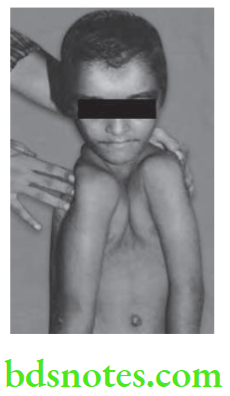
- It primarily affects skull, clavicle and dentition.
- Head is brachycephalic or wide or short.
- Nasal bridge is depressed with broad base.
- In skull, fontanelles remain open or at least exhibit delayed closing.
- Lacrimal and zygotic bone remains underdeveloped.
- Sagittal suture is sunken and gives skull the flat appearance.
- Nasal bridge is depressed with broad base.
Cleidocranial Dysostosis: Symptoms, Causes, and Diagnosis
Marie and Sainton disease
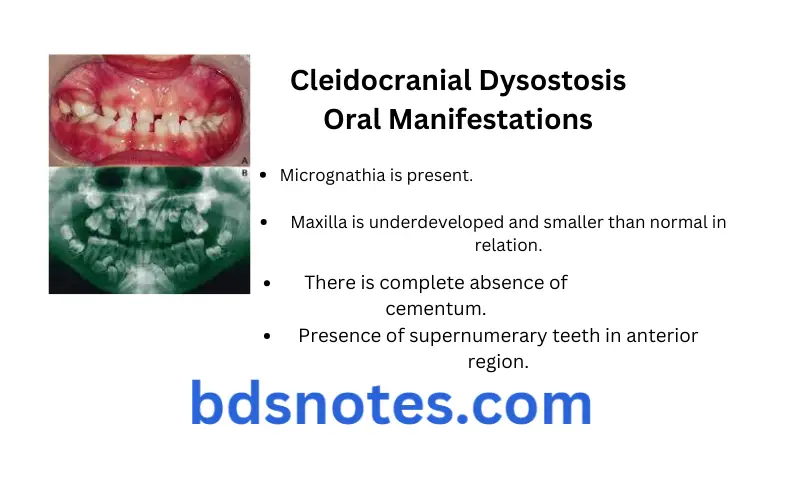
Cleidocranial Dysostosis Oral Manifestations
- Micrognathia is present.
- Maxilla is underdeveloped and smaller than normal in relation.
- Prolonged retention of primary dentition and delayed eruption of permanent dentition.
- There is complete absence of cementum.
- Presence of supernumerary teeth in anterior region.
- Roots of teeth are often short and thinner than normal.
- There is hypoplasia of enamel.
- High arch palate and cleft palate can be present.
Cleidocranial Dysostosis Radiographic Features
- Skull film reveals the presence of open sutures, wormian bones, a wide cranium, and delayed ossification of fontanelles.
- Evaluation of the chest radiograph reveals the absence of clavicles.
- Jaws are flattened, and there is overgrowth of the cranial base anteroposteriorly.
- Jaw examination reveals prolonged retention of primary dentition, multiple superanumerary teeth, and a small, underdeveloped jaw.
- Roots of the teeth are short and thin.
Cleidocranial Dysostosis: Clinical Features and Pathophysiology
Inherited skeletal dysplasias
Cleidocranial Dysostosis Management
- Not specific.
- The patient consists of supernumerary teeth, which can be extracted, and prosthetic replacement of teeth can be done.
- An unerupted tooth can be extracted orthodontically.
Leave a Reply