• Skip to main content
  • Skip to secondary menu
  • Skip to primary sidebar
  • About Us
  • Terms of Use
  • Privacy Policy
  • Disclaimer
  • Contact Us
  • Sitemap

BDS Notes

BDS notes, Question and Answers

  • Public Health Dentistry
  • Periodontics
  • Pharmacology
  • Pathology
  • Orthodontics
    • Anchorage In Orthodontics
    • Mandibular Growth, Functional Matrix
    • Retention and Relapse
  • General Surgery
    • Cysts: Types, Causes, Symptoms
    • Maxillofacial Fractures, Disorders, and Treatments
    • Lymphatic Disorders
    • Neurological and Facial Disorders
  • Temporal And Infratemporal Regions
    • Spinal and Neuroanatomy
  • Dental Materials
    • Dental Amalgam
Home » Epulis

Epulis

November 3, 2025 by Kristensmith Taylor Leave a Comment

Epulis

Write a short note on epulis.
Answer:

  • Epulis is a fibrous growth of oral soft tissue and is very common.
  • Epulis is a lesion that occurs on the gingiva and is localized hyperplasia of connective tissue following trauma or inflammation in the area.

Epulis

Types of Epulis

  • Congenital epulis
  • Fibrous epulis
  • Pregnancy epulis
  • Giant cell epulis
  • Myelomatous epulis
  • Sarcomatous epulis
  • Carcinomatous epulis.

Epulis Clinical Features

  • It occurs at the age of 10 to 40 years.
  • Female predilection is present.
  • The most affected sits are the lip, gingiva, tongue, palate, and vestibule. The lesion is more common in the maxillary anterior region.
  • The lesion is an elevated, pedunculated, or sessile mass with a smooth, lobulated, or warty surface that is ulcerated.
  • On manipulation, the ulcer bleeds.
  • The lesion is pink to red to purple in color depending on the age of the lesion. It is usually painless and is soft in consistency.
  • The size of the lesion ranges from 1 mm to centimeters.

Types of epulis

Epulis Histopathology

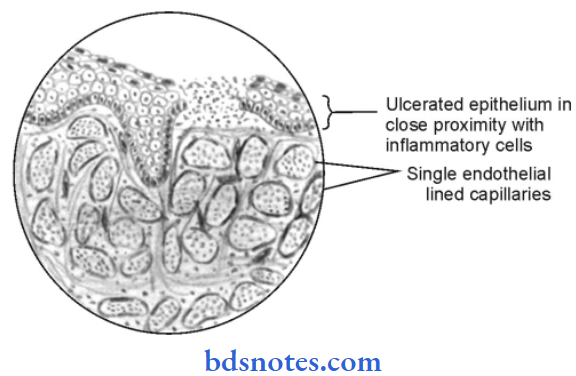
  • The overlying epithelium is thin and atrophic. At times it is hyperplastic too.
  • The surface of the epithelium is usually ulcerated and is replaced by thick fir in the purulent membrane.
  • Underlying connective tissue has a number of endothelial-lined vascular spaces engorged with RBCs and extreme proliferation of fibroblasts and budding endothelial
    cells.

Pyogenic granuloma gum

  • There is a presence of moderate infiltration of PMN leucocytes, lymphocytes, and plasma cells.
  • Areas of hemorrhage and hemosiderin pigmentation is seen in connective tissue stroma.
  • Histologically epulis is known as pyogenic granuloma.
The Oral Cavity And Salivary Glands Pyogenic Granuloma

Filed Under: Pathology

Reader Interactions

Leave a Reply Cancel reply

Your email address will not be published. Required fields are marked *

Primary Sidebar

Recent Posts

  • Branchial Cleft Cyst: Background, Pathophysiology, Etiology
  • Maxillary Nerve: Origin, Course, And Branches
  • The Father Of Anatomy And A Great Anatomist Herophilus
  • Bone Structure – Anatomy
  • The External Carotid Artery: Anatomy, Branches, And Functions
  • Occipitofrontalis Muscle
  • Superficial Temporal Artery
  • Platysma Muscle
  • Cartilage
  • Cauda Equina And Conus Medullaris Syndromes
  • Subcutaneous Injections And Device Management
  • Types Of Circulation: Pulmonary, Systemic, And Portal
  • Structure Of Skeletal Muscle
  • Elastic Cartilage
  • Cellular Organelles And Structure
  • The Golgi Apparatus – The Cell
  • The Cytoplasmic Inclusions Of Certain Plant Cells
  • Dental Abscess
  • Laser Surgery
  • Our Facial Muscles And Their Functions

Copyright © 2026 · Magazine Pro on Genesis Framework · WordPress · Log in