• Skip to main content
  • Skip to secondary menu
  • Skip to primary sidebar
  • About Us
  • Terms of Use
  • Privacy Policy
  • Disclaimer
  • Contact Us
  • Sitemap

BDS Notes

BDS notes, Question and Answers

  • Public Health Dentistry
  • Periodontics
  • Pharmacology
  • Pathology
  • Orthodontics
    • Anchorage In Orthodontics
    • Mandibular Growth, Functional Matrix
    • Retention and Relapse
  • General Surgery
    • Cysts: Types, Causes, Symptoms
    • Maxillofacial Fractures, Disorders, and Treatments
    • Lymphatic Disorders
    • Neurological and Facial Disorders
  • Temporal And Infratemporal Regions
    • Spinal and Neuroanatomy
  • Dental Materials
    • Dental Amalgam
Home » Oral Thrush

Oral Thrush

November 3, 2025 by Kristensmith Taylor Leave a Comment

Oral Thrush

Write a short note on oral thrush.
Or
Discuss in short oral thrush.
Answer:

  • Oral thrush is also known as pseudomembranous candidiasis.
  • It is a superficial infection of the upper layer of the oral mucous membrane and results in the formation of patchy white plaque or flocks on the mucosal surface.

Oral thrush Pathogenesis

  • Overgrowth of yeast on oral mucosa causes desquamation of oral epithelial cells and there is an accumulation of bacteria, necrotic tissue, and keratin.
  • Debris combines to form pseudomembrane and adhere closely to the oral mucosa.

Oral thrush

Oral thrush Etiology

  • Hormonal disturbances
  • Local or systemic steroids therapy
  • Xerostomia
  • Poor oral hygiene
  • Denture wearing
  • Heavy smoking
  • Prolong antibiotic therapy.

Oral Thrush Laboratory Diagnosis of Candidiasis

  • Fragments of plaque material are smeared on a microscopic slide, macerated with 20% potassium hydroxide, and examined for typical hyphae.
  • Gram Stained smears from lesions or exudates show budding Gram-positive cells.
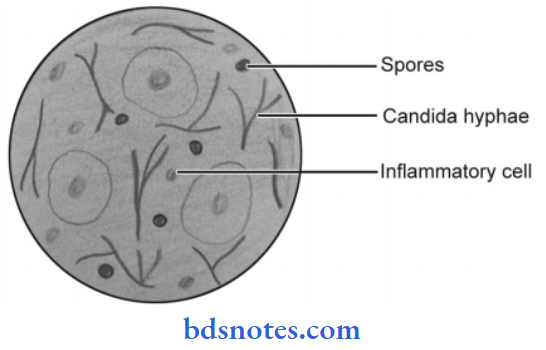
The Oral Cavity And Salivary Glands Candida Albicans (PAS)

  • The sample can also be cultured on Sabouraud’s broth and ordinary bacteriological culture. Colonies appear creamy white, smooth, and with a yeasty odor.
  • Candida albicans alone form chlamydospores on cornmeal agar culture at 20°C.

White patches in mouth

  • A rapid method of identifying Candida albicans is based on its ability to form germ tubes within 2 hours when incubated in human serum at 37°C.
  • By the PAS method of staining Candida hyphae and yeasts should be recognized. The PAS method stains the carbohydrates of fungal cell walls and organisms are identified by bright magenta color. Hyphae are 2µm in diameter, vary in length, and may show branching.

Filed Under: Pathology

Reader Interactions

Leave a Reply Cancel reply

Your email address will not be published. Required fields are marked *

Primary Sidebar

Recent Posts

  • Branchial Cleft Cyst: Background, Pathophysiology, Etiology
  • Maxillary Nerve: Origin, Course, And Branches
  • The Father Of Anatomy And A Great Anatomist Herophilus
  • Bone Structure – Anatomy
  • The External Carotid Artery: Anatomy, Branches, And Functions
  • Occipitofrontalis Muscle
  • Superficial Temporal Artery
  • Platysma Muscle
  • Cartilage
  • Cauda Equina And Conus Medullaris Syndromes
  • Subcutaneous Injections And Device Management
  • Types Of Circulation: Pulmonary, Systemic, And Portal
  • Structure Of Skeletal Muscle
  • Elastic Cartilage
  • Cellular Organelles And Structure
  • The Golgi Apparatus – The Cell
  • The Cytoplasmic Inclusions Of Certain Plant Cells
  • Dental Abscess
  • Laser Surgery
  • Our Facial Muscles And Their Functions

Copyright © 2026 · Magazine Pro on Genesis Framework · WordPress · Log in