• Skip to main content
  • Skip to secondary menu
  • Skip to primary sidebar
  • About Us
  • Terms of Use
  • Privacy Policy
  • Disclaimer
  • Contact Us
  • Sitemap

BDS Notes

BDS notes, Question and Answers

  • Public Health Dentistry
  • Periodontics
  • Pharmacology
  • Pathology
  • Orthodontics
    • Anchorage In Orthodontics
    • Mandibular Growth, Functional Matrix
    • Retention and Relapse
  • General Surgery
    • Cysts: Types, Causes, Symptoms
    • Maxillofacial Fractures, Disorders, and Treatments
    • Lymphatic Disorders
    • Neurological and Facial Disorders
  • Temporal And Infratemporal Regions
    • Spinal and Neuroanatomy
  • Dental Materials
    • Dental Amalgam
Home » Scapular Region

Scapular Region

November 1, 2025 by Joankessler parkland Leave a Comment

Scapular Region

Question 1. Give the origin, insertion, nerve supply and actions of the deltoid muscle.
Answer.

The deltoid is a three-in-one muscle. It is a strong triangular muscle covering the shoulder like a hood. It is responsible for the rounded contour of the shoulder.

Clavicle Acromion Scapula To Humerus

Deltoid Muscle Origin

Anterior unipennate part:

From the anterior border and upper surface of the lateral one-third of the clavicle.

scapular region anatomy

Intermediate multipennate part:

From the lateral border of the acromion process of the scapula.

Deltoid muscle anatomy

Posterior unipennate part:

From the lower lip of the crest of the spine of the scapula.
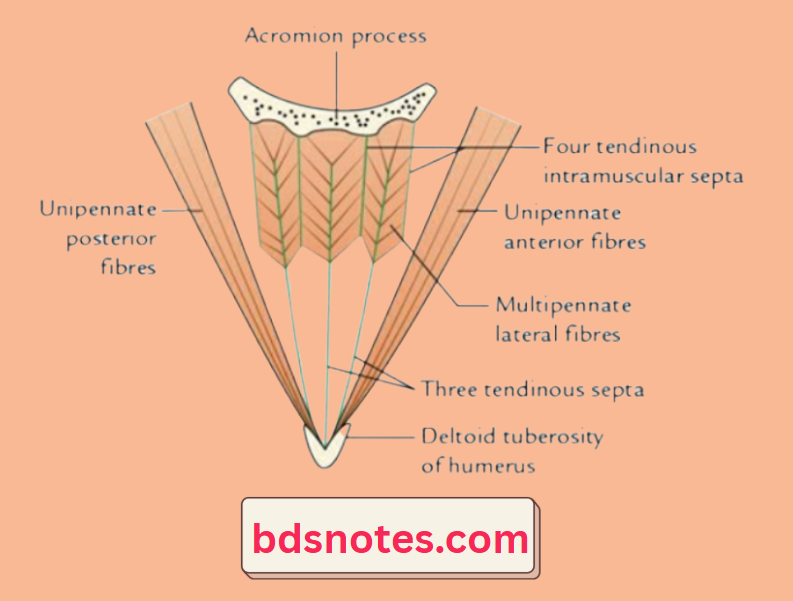
Deltoid Muscle Fiber Architecture Diagram

Deltoid Muscle  Insertion

In the V-shaped deltoid tuberosity on the lateral aspect of the shaft of the humerus.

Deltoid Muscle  Nerve Supply

Axillary/circumflex nerve.

Deltoid Muscle  Actions

Deltoid origin and insertion

  • Lateral (acromial) fibres cause abduction of the shoulder joint from 15° to 90°.
  • Anterior (clavicular) fibres cause medial rotation and flexion of the shoulder joint.
  • Posterior (spinous) fibres cause lateral rotation and extension of the shoulder joint (i.e. they draw the arm backwards and rotate the humerus laterally).

Filed Under: Upper Limb

Reader Interactions

Leave a Reply Cancel reply

Your email address will not be published. Required fields are marked *

Primary Sidebar

Recent Posts

  • Branchial Cleft Cyst: Background, Pathophysiology, Etiology
  • Maxillary Nerve: Origin, Course, And Branches
  • The Father Of Anatomy And A Great Anatomist Herophilus
  • Bone Structure – Anatomy
  • The External Carotid Artery: Anatomy, Branches, And Functions
  • Occipitofrontalis Muscle
  • Superficial Temporal Artery
  • Platysma Muscle
  • Cartilage
  • Cauda Equina And Conus Medullaris Syndromes
  • Subcutaneous Injections And Device Management
  • Types Of Circulation: Pulmonary, Systemic, And Portal
  • Structure Of Skeletal Muscle
  • Elastic Cartilage
  • Cellular Organelles And Structure
  • The Golgi Apparatus – The Cell
  • The Cytoplasmic Inclusions Of Certain Plant Cells
  • Dental Abscess
  • Laser Surgery
  • Our Facial Muscles And Their Functions

Copyright © 2026 · Magazine Pro on Genesis Framework · WordPress · Log in