Gas Gangrene
Write The Method Of the Spread Of Gas Gangrene And Write The Staining And Morphology Of the Organism Producing It.
Answer:
Method Of Spread Of Gas Gangrene
Clostridia release collagenase and hyaluronidase that degrade extracellular matrix proteins and contribute to bacterial invasiveness, but their most powerful virulence factors are the many toxins they produce. C. perfringens secretes 12 toxins, the most important of which is alpha toxin.
Alpha toxin is a phospholipase C that degrades lecithin, a major component of the cell membrane, and so destroys red blood cells, platelets, and muscle cells, causing myonecrosis.
The alpha toxin also has a sphingomyelinase activity that contributes to nerve sheath damage. The O toxin binds cholesterol and forms a membrane-destabilizing pore that causes leukocyte lysis in the lesions of gas gangrene.
Gas gangrene
Gas Gangrene Morphology of Organism
Clostridium perfringens leads to gas gangrene. Morphology of C. perfringens is:
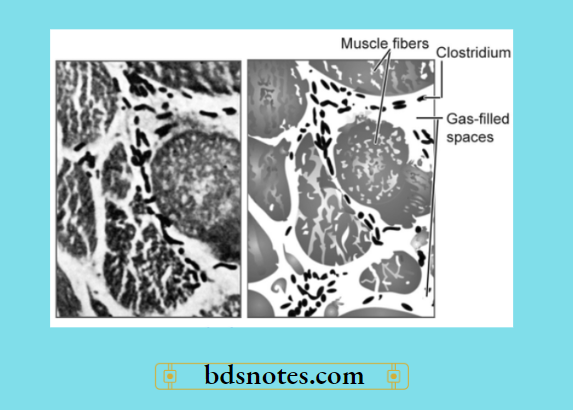
- It is a plump, Gram-positive bacillus with straight, parallel sides and rounded or truncated ends about 4 to 6 microns × 1 micron.
- It may occur singly or in chains.
- It is pleomorphic.
- It is capsulated and non-motile.
- It is filamentous, and involution forms are common.
Gas gangrene treatment
Gas Gangrene Staining Of Organism
C. perfringens is stained by Gram stain and is a Gram-positive organism.
Leave a Reply