• Skip to main content
  • Skip to secondary menu
  • Skip to primary sidebar
  • About Us
  • Terms of Use
  • Privacy Policy
  • Disclaimer
  • Contact Us
  • Sitemap

BDS Notes

BDS notes, Question and Answers

  • Public Health Dentistry
  • Periodontics
  • Pharmacology
  • Pathology
  • Orthodontics
    • Anchorage In Orthodontics
    • Mandibular Growth, Functional Matrix
    • Retention and Relapse
  • General Surgery
    • Cysts: Types, Causes, Symptoms
    • Maxillofacial Fractures, Disorders, and Treatments
    • Lymphatic Disorders
    • Neurological and Facial Disorders
  • Temporal And Infratemporal Regions
    • Spinal and Neuroanatomy
  • Dental Materials
    • Dental Amalgam
Home » Diseases Of Dental Pulp Question And Answers

Diseases Of Dental Pulp Question And Answers

April 6, 2024 by Tanuja Puram Leave a Comment

Diseases Of Dental Pulp Question And Answers

Question 1. Write short note on pulp polyp.
Answer. It is also called as chronic hyperplastic pulpitis or pulpitis aperta.

  • It is a productive pulpal inflammation due to an extensive carious exposure of young pulp.
  • It is characterized by development of granulation tissue, covered at times by epithelium and resulting from longstanding low-grade infection.

“Steps to explain causes of dental pulp diseases: Trauma vs infection: Q&A guide”
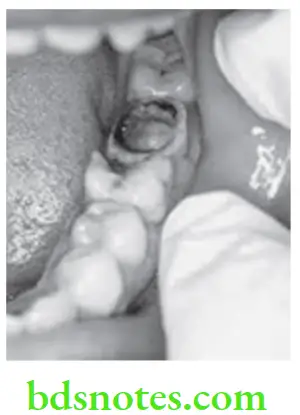
Oral Medicine Diseases Of Dental Pulp Pulp Polyp

“Understanding dental pulp diseases through FAQs: Q&A explained”

Pulp Polyp Etiology

  • Slow progressive carious exposure of pulp.
  • For development of hyperplastic pulp, a large open cavity, a young resistant pulp and a chronic low-grade stimulus.
  • Mechanical irritation from chewing and bacterial infection often provides stimuli.

Diseases of Dental Pulp: Symptoms, Diagnosis, and Treatment

Read And Learn More:  Oral Medicine Question And Answers

“Importance of studying dental pulp diseases for better diagnostic outcomes: Questions explained”

Pulp Polyp Clinical Features

  • Pulp polyp appears as small, pinkish, red lobulated mass, which protrudes from pulp chamber and fills up the carious cavity.
  • The condition is seen in young adults and children.
  • It commonly develops in deciduous molar and first permanent molars.
  • The affected tooth has a large open carious cavity, which is present for long duration.
  • The lesion bleeds profusely on provocation.
  • The involved tooth is painless and is sensitive to thermal stimuli.

“Common challenges in diagnosing dental pulp diseases effectively: FAQs provided”

Pulp Polyp Radiographic Features

It will show a large open cavity with direct access to pulp chamber.

Pulp Polyp Management

  • Elimination of polypoid tissue, followed by extirpation of pulp.
  • After removing hyperplastic tissues, bleeding can be controlled by pressure.
  • Extraction of tooth can also be done.

Filed Under: Oral Medicine

Reader Interactions

Leave a Reply Cancel reply

Your email address will not be published. Required fields are marked *

Primary Sidebar

Recent Posts

  • Branchial Cleft Cyst: Background, Pathophysiology, Etiology
  • Maxillary Nerve: Origin, Course, And Branches
  • The Father Of Anatomy And A Great Anatomist Herophilus
  • Bone Structure – Anatomy
  • The External Carotid Artery: Anatomy, Branches, And Functions
  • Occipitofrontalis Muscle
  • Superficial Temporal Artery
  • Platysma Muscle
  • Cartilage
  • Cauda Equina And Conus Medullaris Syndromes
  • Subcutaneous Injections And Device Management
  • Types Of Circulation: Pulmonary, Systemic, And Portal
  • Hierarchical Organization Of Skeletal Muscle Tissue
  • Elastic Cartilage Histology Short Note For Medical Exams
  • Cellular Organelles And Structure
  • The Golgi Apparatus – The Cell
  • The Cytoplasmic Inclusions Of Certain Plant Cells
  • Dental Abscess
  • Laser Surgery
  • Our Facial Muscles And Their Functions

Copyright © 2026 · Magazine Pro on Genesis Framework · WordPress · Log in