Endodontic Materials
Question 1. Write a short note on root canal filling materials.
Answer:
Root canal filling materials are also known as root canal obturating materials.
Ideal Requirements of Root Canal Filling Material:
- Root Canal Filling Material should be easy to introduce in root canals.
- Root Canal Filling Material should be able to seal canals in all dimensions.
- Root Canal Filling Material should be dimensionally stable.
Read And Learn More: Dental Materials Question And Answers
- Root Canal Filling Material should be bacteriostatic.
- Root Canal Filling Material should be radiopaque.
- Root Canal Filling Material should not stain the tooth structure.
- Root Canal Filling Material should be sterile or easily sterilizable.
- Root Canal Filling Material should be easy to remove from root canals, if necessary.
- Root Canal Filling Material should be non-irritant to perpendicular tissues.
- Root Canal Filling Material should be non-cariogenic and non-mutagenic.
- Root Canal Filling Material should not provoke an immune reaction.

Classification of Root Canal Filling Material:
Root canal filling materials are classified as:
- Metals:
- Silver points
- Titanium wires
- Stainless steel fies
- Plastics:
- Gutt-percha
- Resilon
- Pastes:
- Mineral trioxide aggregate
- Zinc oxide eugenol
- Calcium hydroxide paste
- Iodoform pastes
- Chloropercha
- Eucapercha
- Biocalex
- N2
Silver Points of Root Canal Filling Material:
Silver points or cones were the most widely used root canal filling material between 1940 to 1960 due to their bactericidal effect. These silver points are largely replaced by gutt-percha and are rarely used.
Gutta-percha of Root Canal Filling Material:
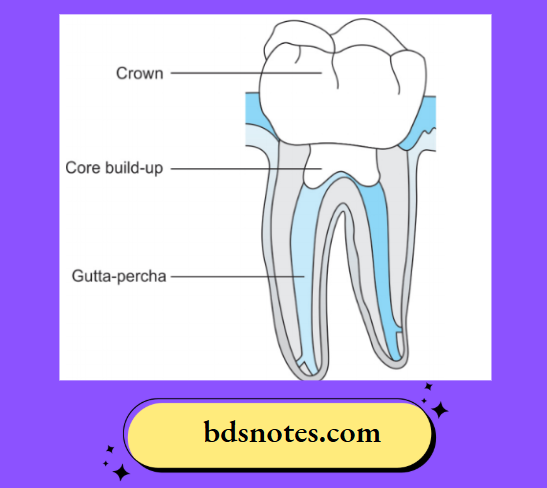
Gutta-percha of Root Canal Filling Material is a polymeric resin-like material that is obtained from the coagulation of latex produced by Palaquium gutt tree. Guttpercha is supplied in point or pellet form to be used as root canal filling material. It is compactable and adapts nicely to the irregularities as well as the contour of the canal by lateral and vertical
condensation methods. It is non-allergic, radiopaque, and does not discolor the tooth surface.
Resilon–Epiphany Root Canal Filling System:
Resilon–Epiphany root canal filing system is an alternative to gutta-percha. It has resin obturating points which are sealed with dual cure and hydrophilic resin sealer. This system consists
of three parts:
- Resilon: A thermoplastic synthetic polymer-based root canal filling material.
- Epiphany sealer: It is a resin-based composite that forms a bond to the dentin wall as well as the core material. It sets with chemical reaction and halogen curing unit.
- Primer: It prepares the canal wall for contact with resin and sealer.
Paste Type Obturating Material:
Various paste-type products are used as obturating materials because they have sufficient volume to maintain a seal. Materials used are zinc oxide eugenol-based pastes, epoxy resins, calcium hydroxide, etc. many of these materials are of two-way use, i.e. they can be used as sole obturating material or as a sealer.
Question 2. Write a short note on Gutt-Percha.
Answer:
Gutt-percha was initially used as a restorative material and later developed as root canal-filling material. Historically Gutt-percha was used as a splint for holding fractured joints, for controlling hemorrhage from bleeding sockets. Gutt-percha was derived from Brazilian trees (Palaquium).
Classification of Gutta-Percha:
1. According to the phase:
- Alpha
- Beta
- Gamma
2. According to the size:
- Standardized gutta-percha
- Non–standardized gutta-percha
3. According to the taper:
- 0.02
- 0.04
- 0.06 etc.
4. According to the mode of use:
- Cold gutta-percha
- Chemically softened gutta-percha
- Thermally softened gutta-percha
5. According to calibration:
- Calibrated
- Non-caliberated
6. According to medicament incorporated:
- Medicated
- Non-medicated.
Composition of Commercially Available Gutta-Percha:
- Matrix: Gutta-percha 18–22%
- Filler: Zinc oxide 59-75%
- Radiopacifirs: Heavy metal sulfates 1-18%
- Plasticizers: Waxes or rosins 1-4%.
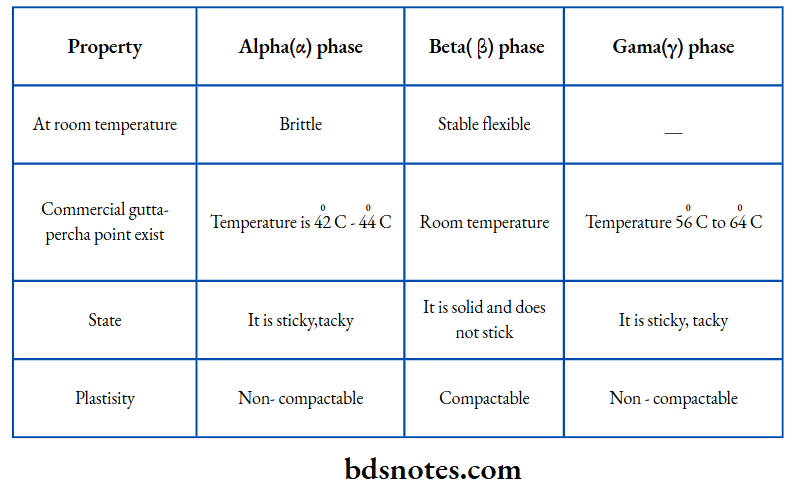
Phases of Gutta-Percha:
- Alpha: It is running tacky and sticky.
- Beta: It is solid, compactable, and elongated
- Gamma: It is an unstable form
Properties of various Phases of Gutta–Percha:
Advantages of Gutta–Percha:
- Adaptation to canal walls is good.
- Gutta–Percha is inert. This makes it a non-reactive material.
- Gutta–Percha is dimensionally stable.
- Well, tissue tolerance.
- Due to the property of radiopacity, it is recognizable on radiograph.
- Gutta–Percha becomes plastic when heated.
- Gutta–Percha gets dissolved in solvents like chloroform, eucalyptus oil.
Disadvantages of Gutta–Percha:
- Gutta–Percha lacks rigidity, so cannot be used in small root canals.
- Easily displaced by pressure.
- Gutta–Percha lacks adhesive quality.
Applications/Uses/Indications:
- As an obturating material
- For tracing a sinus tract
- In thermal pulp testing
- As temporary stopping in the inlay cavity.
Limitations of Gutta-percha:
- Gutta–Percha is not molecularly condensed and is not compressible but as it is softened by heat treatment it is compacted against the canal walls.
- A sealer is used to seal the gap between gutta–percha and the walls of the canal.
Leave a Reply