• Skip to main content
  • Skip to secondary menu
  • Skip to primary sidebar
  • About Us
  • Terms of Use
  • Privacy Policy
  • Disclaimer
  • Contact Us
  • Sitemap

BDS Notes

BDS notes, Question and Answers

  • Public Health Dentistry
  • Periodontics
  • Pharmacology
  • Pathology
  • Orthodontics
    • Anchorage In Orthodontics
    • Mandibular Growth, Functional Matrix
    • Retention and Relapse
  • General Surgery
    • Cysts: Types, Causes, Symptoms
    • Maxillofacial Fractures, Disorders, and Treatments
    • Lymphatic Disorders
    • Neurological and Facial Disorders
  • Temporal And Infratemporal Regions
    • Spinal and Neuroanatomy
  • Dental Materials
    • Dental Amalgam
Home » Fishman’s Skeletal Maturity Indicators in Orthodontics

Fishman’s Skeletal Maturity Indicators in Orthodontics

May 19, 2023 by Tanuja Puram Leave a Comment

Skeletal Maturity Indicators

“What are Fishman’s Skeletal Maturity Indicators and why do they matter?”

 Leonard S Fishman in 1982 had proposed this system.
  • Fishman had used four anatomical sites, i.e. location on thumb, third figer, fit figer and radius.
  • Eleven discrete adolescent skeletal maturity indicators covering entire period of adolescent development are described.
  • Fishman system of interpretation uses four stages of bone maturation which are:
    • Epiphysis equal in width to diaphysis
    • Appearance of adductor sesamoid of thumb
    • Capping of epiphysis
    • Fusion of epiphysis.

“Understanding the role of Fishman’s Skeletal Maturity Indicators in orthodontics”

Read And Learn More: Orthodontics Question And Answers

  • Following are the Fishman’s skeletal maturity indicators:
    • S.M.I 1: The third finger proximal phalanx shows equal width of epiphysis and diaphysis.
    • S.M.I 2: Width of epiphysis is equal to that of diaphysis in the middle phalanx of third finger.
    • S.M.I 3: Width of epiphysis is equal to that of diaphysis in the middle phalanx of fit finger.
    • S.M.I 4: Appearance of adductor sesamoid of the thumb
    • S.M.I 5: Capping of epiphysis seen in distal phalanx of third finger.
    • S.M.I 6: Capping of epiphysis seen in middle phalanx of third finger.
    • S.M.I 7: Capping of epiphysis seen in middle phalanx of fit finger.
    • S.M.I 8: Fusion of epiphysis and diaphysis in the distal phalanx of third figer.
    • S.M.I 9: Fusion of epiphysis and diaphysis in the proximal phalanx of third figer.
    • S.M.I 10: Fusion of epiphysis and diaphysis in the middle phalanx of third figer.
    • S.M.I 11: Fusion of epiphysis and diaphysis is seen in the radius.
“Importance of studying Fishman’s Skeletal Maturity Indicators for better outcomes”
S.M.I denotes skeletal maturity indicator.
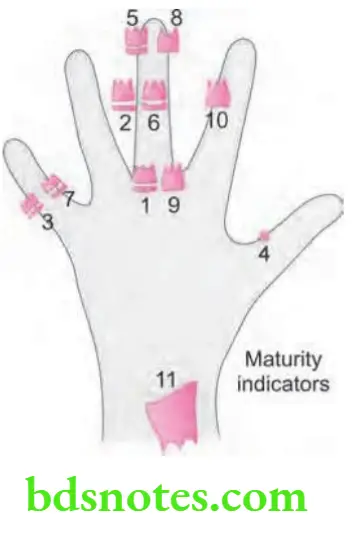
Orthodontics Skeletal Maturity Indicators Fishman's Skeletal Maturity Indicator
“Common challenges in applying Fishman’s Skeletal Maturity Indicators effectively”

Filed Under: Orthodontics

Reader Interactions

Leave a Reply Cancel reply

Your email address will not be published. Required fields are marked *

Primary Sidebar

Recent Posts

  • Branchial Cleft Cyst: Background, Pathophysiology, Etiology
  • Maxillary Nerve: Origin, Course, And Branches
  • The Father Of Anatomy And A Great Anatomist Herophilus
  • Bone Structure – Anatomy
  • The External Carotid Artery: Anatomy, Branches, And Functions
  • Occipitofrontalis Muscle
  • Superficial Temporal Artery
  • Platysma Muscle
  • Cartilage
  • Cauda Equina And Conus Medullaris Syndromes
  • Subcutaneous Injections And Device Management
  • Types Of Circulation: Pulmonary, Systemic, And Portal
  • Structure Of Skeletal Muscle
  • Elastic Cartilage
  • Cellular Organelles And Structure
  • The Golgi Apparatus – The Cell
  • The Cytoplasmic Inclusions Of Certain Plant Cells
  • Dental Abscess
  • Laser Surgery
  • Our Facial Muscles And Their Functions

Copyright © 2026 · Magazine Pro on Genesis Framework · WordPress · Log in