Cementicles And Cellular Elements Of Dental Pulp
Question 1. Cementicles
Answer:
- A canticle is a small, spherical, or ovoid calcified mass embedded within or attached to the cementum layer on the root surface of a tooth or lying free within the periodontal ligament
- They tend to occur in elderly individuals.
Types:
There are 3 types:
- Free cementite – not attached to the cementum
- Attached (sessile) cementite – attached to the cementum surface (also termedexocementosis)
- Embedded (interstitial) cementite- with advancing age, the cementum thickens, and the canticle may become incorporated into the cementum layer.
Features:
- They may appear singly or in groups
- Most commonly found at the tip of the root.
- Their size is variable (about 0.2 mm – 0.3 mm in diameter)
- Cementicles are usually acellular and may contain either fibrillar or fibrillar cementum, or a mixture of both
- Cementicles are the result of dystrophic calcificationCementicles are thought to form when
Causes:
- Calcification due to degenerative changes in the epithelial cell rests of Malassez
- Calcification of thrombosed capillaries in the periodontal ligament
- Microtrauma to Sharpey’s fibers
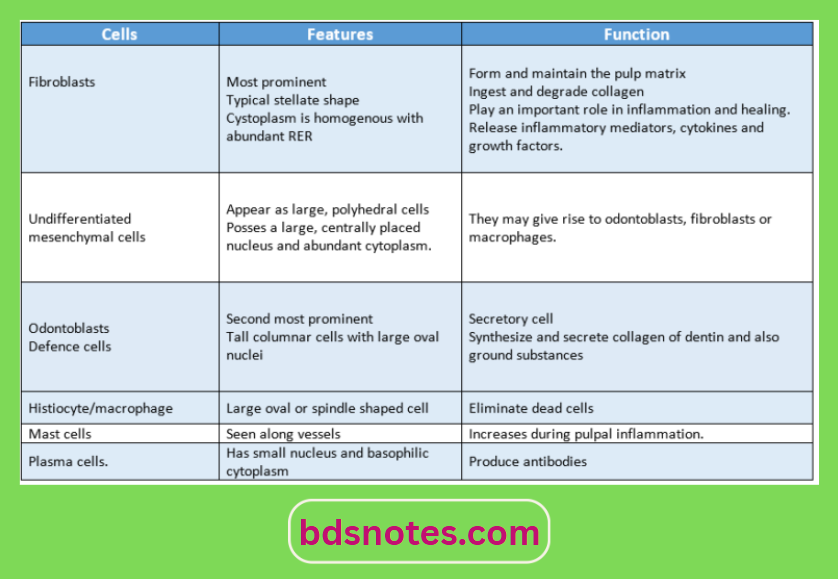
Question 2. Cellular elements of the pulp.
Answer:
Leave a Reply