Transseptal Fibers: The Key To Tooth Stability And Orthodontic Relapse
Question 1. Synthetic cells of PDL.
Answer:
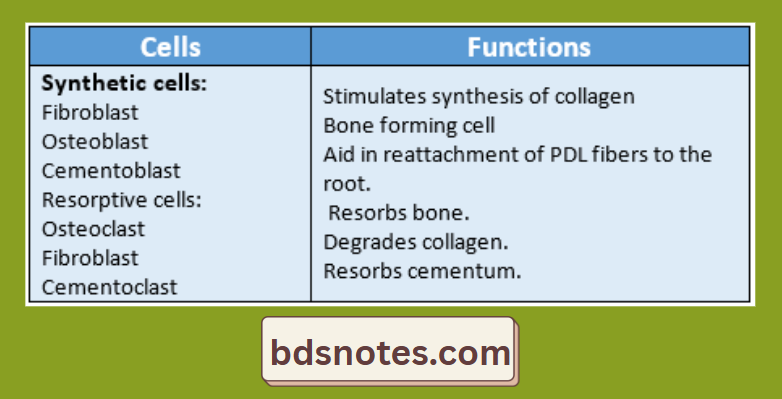
Question 2. Transseptal fibers.
Answer:
- These fibers run interdentally from the cementum apical to the junctional epithelium of one tooth over the alveolar crest to a similar region of the adjacent tooth.
- By these, all tire teeth are connected in an arch.
- They are responsible for post-retention relapse of orthodontic treatment.
- They are capable of turnover and remodeling under normal physiologic conditions and therapeutic tooth movement.
- They ensure clinical stability of tooth position.
Question 3. Bundle fibers of the periodontal membrane.
Answer:
Fiber bundles composing ligament:
1. Dentogingival group:
- Extends from cervical cementum to lamina propria of the free and attached gingiva.
2. Alveologingival group:
- Extends from the bone of the alveolar crest to lamina propria of the free and attached gingiva.
3. Circular group:
- It forms a band around the neck of the tooth.
4. Dentoperiosteal group:
- Runs apically from the cementum up to the alveolar process.
5. Transseptal fiber:
- Run interdentally from the cementum of one tooth to the cementum of the adjacent tooth.
Question 4. Age changes in the periodontal ligament.
Answer:
- The cell number and activity decrease with age
- PDL fibers become attached to the scalloping ends of the alveolar bone.
- PDL activity decreases.
- Destructive changes occur due to the presence of gingival and periodontal diseases in old age.
- Some of the teeth become non-functional.
- PDL width decreases.
Leave a Reply