• Skip to main content
  • Skip to secondary menu
  • Skip to primary sidebar
  • About Us
  • Terms of Use
  • Privacy Policy
  • Disclaimer
  • Contact Us
  • Sitemap

BDS Notes

BDS notes, Question and Answers

  • Public Health Dentistry
  • Periodontics
  • Pharmacology
  • Pathology
  • Orthodontics
    • Anchorage In Orthodontics
    • Mandibular Growth, Functional Matrix
    • Retention and Relapse
  • General Surgery
    • Cysts: Types, Causes, Symptoms
    • Maxillofacial Fractures, Disorders, and Treatments
    • Lymphatic Disorders
    • Neurological and Facial Disorders
  • Temporal And Infratemporal Regions
    • Spinal and Neuroanatomy
  • Dental Materials
    • Dental Amalgam
Home » Epithelial Attachment: The Tooth-Gum Connection

Epithelial Attachment: The Tooth-Gum Connection

February 6, 2026 by Kristensmith Taylor Leave a Comment

Epithelial Attachment: The Tooth-Gum Connection

Question 1. Write briefly about epithelial attachment.
Answer:

Epithelial attachment:

  • It is shown by Stem and confirmed by Listgarten and Schroeder,
  • They showed the mode of attachment of the ameloblasts to the tooth, to be basal lamina to which hemidesmosomes are attached.
  • This is referred to as epithelial attachment.
  • Both reduced ameloblasts and gingival epithelial cells form basal lamina on enamel and cementum
  • Hemidesmosomes of these cells attach to the basal lamina.
  • This basal lamina is referred to as the internal basal lamina.
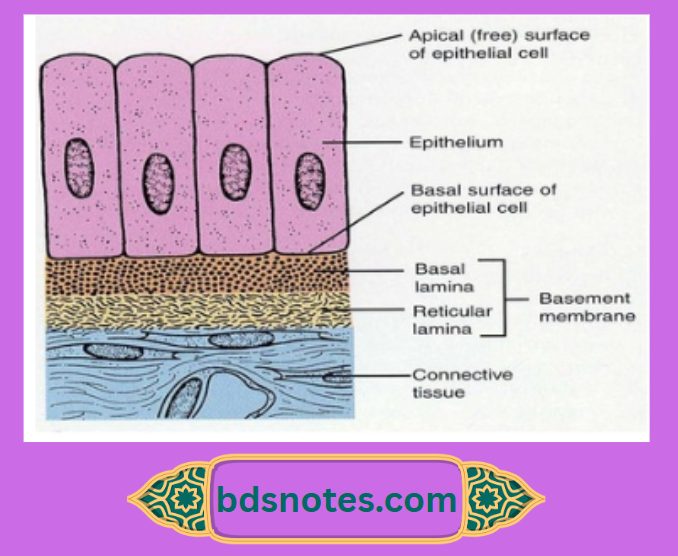
Histology Of Basement Membrane

  •   The lamina propria below the junctional epithelium keeps the epithelial cells of the junctional epithelium immature so that it can develop hemidesmosomes and attach to the tooth.
  • They then migrate over it, with their attachment being maintained by the hemidesmosomes.
  • The hemidesmosomes hold the cells to the basal lamina so that the strength of the attachment is not diminished despite the migration.

Question 2. Circumvallate papillae.
Answer:

  • Location: Just anterior to the sulcus terininalis.
  • Number: 8 – 12 in number.

Structure:

  • Large round structures.
  • They do not protrude above the surface
  • They are surrounded by a deep, circular groove for the opening of ducts of minor salivary glands.
  • They contain a connective tissue core covered by a keratinized epithelium.

Surfaces;

  • Free surface – shows numerous secondary papillae covered by a thin, smooth epithelium.
  • Lateral surface – contains numerous taste buds.

Functions: 

  • Wash out the soluble elements of food
  • The main source of salivary lipase.

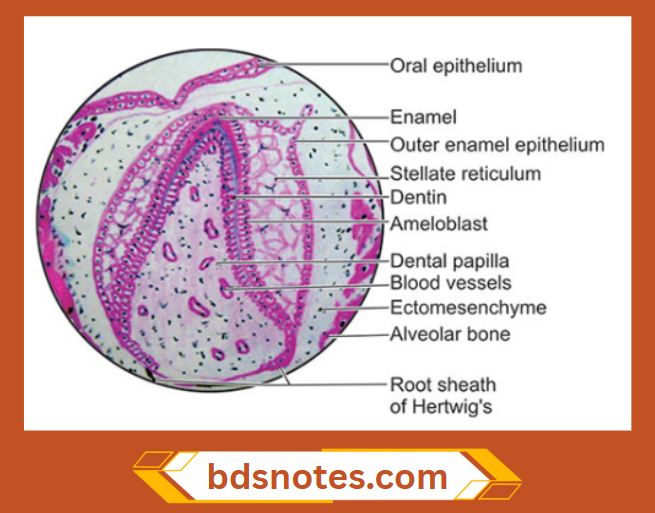
Stages Of Tooth Development

Filed Under: Anatomy

Reader Interactions

Leave a Reply Cancel reply

Your email address will not be published. Required fields are marked *

Primary Sidebar

Recent Posts

  • Branchial Cleft Cyst: Background, Pathophysiology, Etiology
  • Maxillary Nerve: Origin, Course, And Branches
  • The Father Of Anatomy And A Great Anatomist Herophilus
  • Bone Structure – Anatomy
  • The External Carotid Artery: Anatomy, Branches, And Functions
  • Occipitofrontalis Muscle
  • Superficial Temporal Artery
  • Platysma Muscle
  • Cartilage
  • Cauda Equina And Conus Medullaris Syndromes
  • Subcutaneous Injections And Device Management
  • Types Of Circulation: Pulmonary, Systemic, And Portal
  • Structure Of Skeletal Muscle
  • Elastic Cartilage
  • Cellular Organelles And Structure
  • The Golgi Apparatus – The Cell
  • The Cytoplasmic Inclusions Of Certain Plant Cells
  • Dental Abscess
  • Laser Surgery
  • Our Facial Muscles And Their Functions

Copyright © 2026 · Magazine Pro on Genesis Framework · WordPress · Log in