• Skip to main content
  • Skip to secondary menu
  • Skip to primary sidebar
  • About Us
  • Terms of Use
  • Privacy Policy
  • Disclaimer
  • Contact Us
  • Sitemap

BDS Notes

BDS notes, Question and Answers

  • Public Health Dentistry
  • Periodontics
  • Pharmacology
  • Pathology
  • Orthodontics
    • Anchorage In Orthodontics
    • Mandibular Growth, Functional Matrix
    • Retention and Relapse
  • General Surgery
    • Cysts: Types, Causes, Symptoms
    • Maxillofacial Fractures, Disorders, and Treatments
    • Lymphatic Disorders
    • Neurological and Facial Disorders
  • Temporal And Infratemporal Regions
    • Spinal and Neuroanatomy
  • Dental Materials
    • Dental Amalgam
Home » Lining Mucosa: Histology And Its Role In Oral Surgery

Lining Mucosa: Histology And Its Role In Oral Surgery

February 6, 2026 by Kristensmith Taylor Leave a Comment

Lining Mucosa: Histology And Its Role In Oral Surgery

Describe the lining mucosa.
Answer:

  • The oral mucosa covering the underside of the tongue, inside of the lips, cheeks, floor of the mouth vestibule, and alveolar mucosa are classified as lining mucosa.
  • The mucous membrane is movably attached to the deep structures and does not restrict the movement of lips, cheeks, and tongue.
  • Where the lining mucosa covers muscle, the mucosa is fixed to the fascia.

Lining Mucosa Clinical considerations:

  • Surgical incisions require sutures for closure.
  • Injections are easy due to the ready dispersion of fluids.
  • Infections spread rapidly.

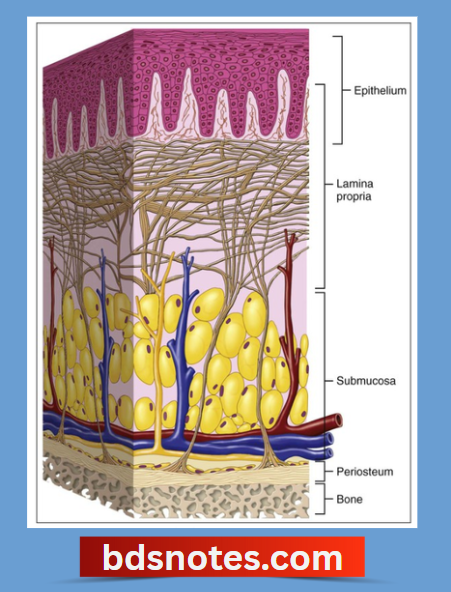
Lining Mucosa Histology:

1. Epithelium.

  • Thick (400 pm)
  • Non-keratinized stratified squamous epithelium.
  • The surface is flexible to withstand stretching.

2. Junction between epithelium and lamina propria.

  • Smooth
  • Slender connective tissue papillae often penetrate into the epithelium.

3. Lamina propria.

  • Thicker
  • Contains fewer irregular collagen fibers.
  • This helps the mucosa to be stretched to a certain extent.
  • Also contains elastic fibers to control the extensibility of the mucosa.

4. Submucosa.

  • The mucosa of the soft palate is separated from the loose and highly glandular submucosa by a layer of elastic fibers.

Attachments:

1. Lining mucosa covering the muscle.

  • Attached by a mixture of collagen and elastic fibers

2. the alveolar mucosa and mucosa covering the floor of the mouth.

  • Attached loosely to the underlying structures by a thick submucosa.

3. Mucosa of the underside of the tongue.

  • Bound firmly to the underlying muscle.

Lining Mucosa  Functions:

1. Collagen fibers.

  • Helps to stretch the mucosa to a certain limit.

2. Elastic fibers.

  • Tend to control the extensibility of the mucosa.
  • During mastication.
  • Retract the mucosa toward the muscle.
  • Prevent it from bulging between the teeth and being bitten.
  • Tend to restore the mucosa to its resting position after detention.
Epithelium Lamina Propria Submucosa

Filed Under: Anatomy

Reader Interactions

Leave a Reply Cancel reply

Your email address will not be published. Required fields are marked *

Primary Sidebar

Recent Posts

  • Branchial Cleft Cyst: Background, Pathophysiology, Etiology
  • Maxillary Nerve: Origin, Course, And Branches
  • The Father Of Anatomy And A Great Anatomist Herophilus
  • Bone Structure – Anatomy
  • The External Carotid Artery: Anatomy, Branches, And Functions
  • Occipitofrontalis Muscle
  • Superficial Temporal Artery
  • Platysma Muscle
  • Cartilage
  • Cauda Equina And Conus Medullaris Syndromes
  • Subcutaneous Injections And Device Management
  • Types Of Circulation: Pulmonary, Systemic, And Portal
  • Structure Of Skeletal Muscle
  • Elastic Cartilage
  • Cellular Organelles And Structure
  • The Golgi Apparatus – The Cell
  • The Cytoplasmic Inclusions Of Certain Plant Cells
  • Dental Abscess
  • Laser Surgery
  • Our Facial Muscles And Their Functions

Copyright © 2026 · Magazine Pro on Genesis Framework · WordPress · Log in