• Skip to main content
  • Skip to secondary menu
  • Skip to primary sidebar
  • About Us
  • Terms of Use
  • Privacy Policy
  • Disclaimer
  • Contact Us
  • Sitemap

BDS Notes

BDS notes, Question and Answers

  • Public Health Dentistry
  • Periodontics
  • Pharmacology
  • Pathology
  • Orthodontics
    • Anchorage In Orthodontics
    • Mandibular Growth, Functional Matrix
    • Retention and Relapse
  • General Surgery
    • Cysts: Types, Causes, Symptoms
    • Maxillofacial Fractures, Disorders, and Treatments
    • Lymphatic Disorders
    • Neurological and Facial Disorders
  • Temporal And Infratemporal Regions
    • Spinal and Neuroanatomy
  • Dental Materials
    • Dental Amalgam
Home » Understanding Genetic Code And Its Role In Protein Synthesis

Understanding Genetic Code And Its Role In Protein Synthesis

February 6, 2026 by Kristensmith Taylor Leave a Comment

Understanding Genetic Code And Its Role In Protein Synthesis

Question 1. Describe the features of genetic code (or) Characteristics of genetic code
Answer:

1. Universality

  • The same codons are used to code for the same amino acids in all the living organisms

2. Specificity

  • A particular codon always codes for the same amino acids

3. Non-overlapping

  • Genetic code is read from a fixed point as a continuous base sequence

4. Degenerate

  • Most of amino acids have more than one codon
  • This is because there are 61 codons for 20 amino acids

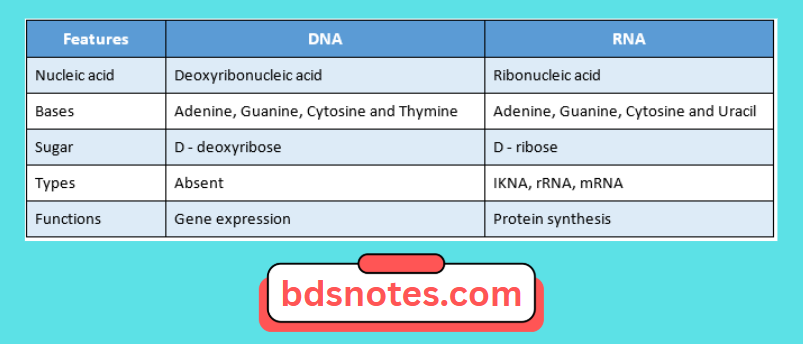
Question 2. Differences between DNA &. RNA.
Answer:
Question 3. Gout
Answer:

  • Gout is a metabolic disorder associated with the overproduction of uric acid
  • Due to excess uric acid, forms crystals of sodium really
  • This gets deposited in the soft tissues, particularly in joints resulting in inflammation of joints and painful gouty arthritis

Types:

1. Primary gout

  • It is an inborn error of metabolism due to the overproduction of uric acid

2. Secondary gout

  • Occurs due to various diseases like various cancers, psoriasis, and increased tissue breakdown.

Treatment:

  • Allopurinol is a drug of choice
  • It is oxidized to alloxanthine by xanthine oxidase
  • Alloxanthine is an inhibitor of xanthine oxidase
  • Thus allopurinol acts by suicide inhibition mechanism

Filed Under: Anatomy

Reader Interactions

Leave a Reply Cancel reply

Your email address will not be published. Required fields are marked *

Primary Sidebar

Recent Posts

  • Branchial Cleft Cyst: Background, Pathophysiology, Etiology
  • Maxillary Nerve: Origin, Course, And Branches
  • The Father Of Anatomy And A Great Anatomist Herophilus
  • Bone Structure – Anatomy
  • The External Carotid Artery: Anatomy, Branches, And Functions
  • Occipitofrontalis Muscle
  • Superficial Temporal Artery
  • Platysma Muscle
  • Cartilage
  • Cauda Equina And Conus Medullaris Syndromes
  • Subcutaneous Injections And Device Management
  • Types Of Circulation: Pulmonary, Systemic, And Portal
  • Structure Of Skeletal Muscle
  • Elastic Cartilage
  • Cellular Organelles And Structure
  • The Golgi Apparatus – The Cell
  • The Cytoplasmic Inclusions Of Certain Plant Cells
  • Dental Abscess
  • Laser Surgery
  • Our Facial Muscles And Their Functions

Copyright © 2026 · Magazine Pro on Genesis Framework · WordPress · Log in