Understanding Chromosomes: The Blueprint Of Life In Every Cell
Question 1. Chromosome.
Answer:
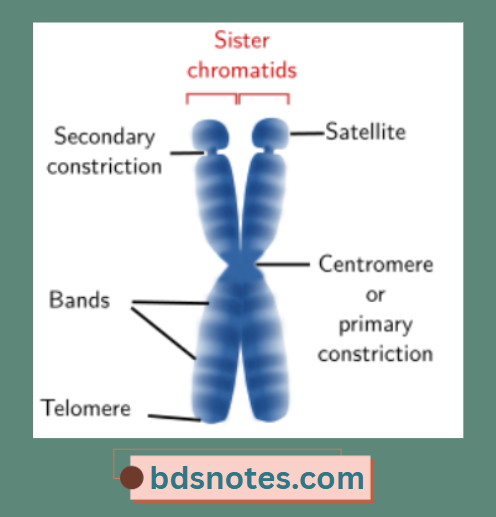
- A typical chromosome is made up of two rod-shaped chromatids which are placed more or less parallel to each other.
- Both chromatids are united to each other at a light staining area called centomere.
- Each chromatid has two arms – one on either side.
Chromosome Signficance:
- Each chromosome bears very large number of structures called genes which are made up of nucleic acid called deoxyribonucleic acid (DNA).
- These genes are involved in synthesis of proteins.
- Chromosome control the development and functioning of cells, by determining what types of proteins will be synthesized in them.
Question 2. DNA (Deoxyribonucleic acid).
Answer:
- It consists of two strands of fibers that are twisted to form double helix.
- The strands are linked to each other at regular intervals.
- Each strand consists of a chain of nucleotides.
- Each nucleotide molecule is made up of
- One molecule of sugar – deoxyribose.
- One molecule of phosphate.
- It is attached to fifth carbon atom of sugar and third carbon atom of sugar of next nucleotide.
- A nitrogenous base [adenine, guanine, cytosine/thymine].
- It is attached to the first carbon atom.
- The DNA molecule is made up of two such polynucleotide chains running in opposite direction.
- Adenine
(A) always pairs with thymine
(T) and cytosine
(C) always pairs with guanine (G).
Leave a Reply