• Skip to main content
  • Skip to secondary menu
  • Skip to primary sidebar
  • About Us
  • Terms of Use
  • Privacy Policy
  • Disclaimer
  • Contact Us
  • Sitemap

BDS Notes

BDS notes, Question and Answers

  • Public Health Dentistry
  • Periodontics
  • Pharmacology
  • Pathology
  • Orthodontics
    • Anchorage In Orthodontics
    • Mandibular Growth, Functional Matrix
    • Retention and Relapse
  • General Surgery
    • Cysts: Types, Causes, Symptoms
    • Maxillofacial Fractures, Disorders, and Treatments
    • Lymphatic Disorders
    • Neurological and Facial Disorders
  • Temporal And Infratemporal Regions
    • Spinal and Neuroanatomy
  • Dental Materials
    • Dental Amalgam
Home » Polyunsaturated Fatty Acids (PUFAs): Heart-Healthy Fats Explained

Polyunsaturated Fatty Acids (PUFAs): Heart-Healthy Fats Explained

February 6, 2026 by Kristensmith Taylor Leave a Comment

Polyunsaturated Fatty Acids (PUFAs): Heart-Healthy Fats Explained

Question 1. Phospholipids.
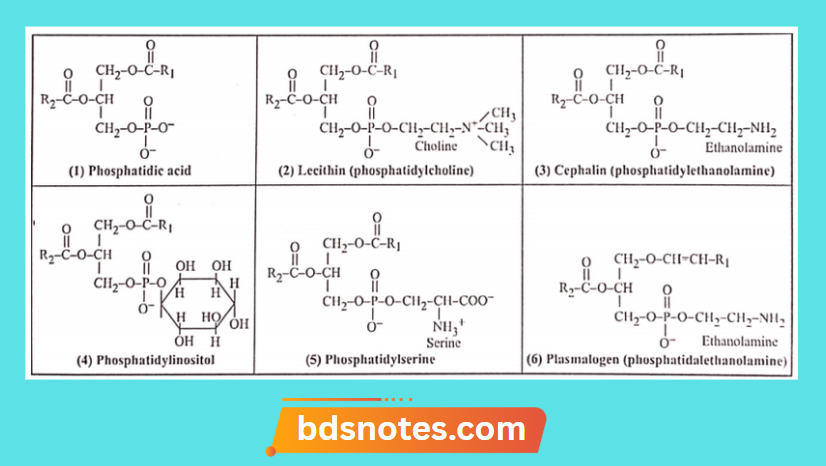
Answer: These are compound lipids containing phosphoric acid along with fatty acids, nitrogenous bases, and alcohol.

Types:
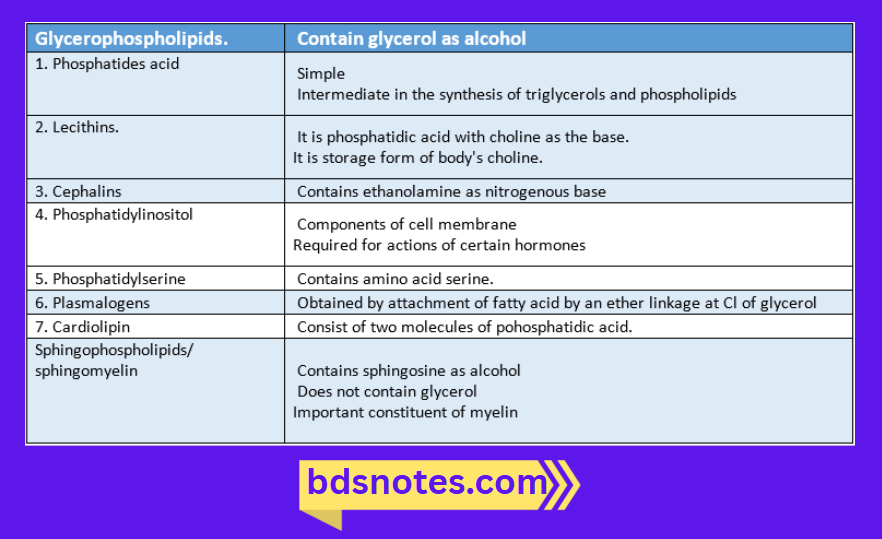
Glycerol Containing Phospholipids

Structure:

Types Of Phospholipids

Functions:

  • Along with proteins forms a structural component of the membrane and regulates its permeability.
  • Maintain conformation of the electron transport chain.
  • Help in the absorption of fat from the intestine.
  • Required for transport of lipids.
  • Prevents the occurrence of fatty liver.
  • Arachidonic acid which is libera led from phospholipids ads as a person loi Urn syllabus of eicosanoids.
  • Help in cholesterol removal from the body by reversal of cholesterol transport.
  • Act as surfactants.
  • Involvement in signal transmission across membranes.
  • Cephalin help in blood clotting.

Question 2. Polyunsaturated fatty acids.
Answer:

Definitions:

Fatty acids with 2 or more double bonds are collectively known as polyunsaturated fatty acids (PUFFA),

Examples:

  • Linoleic acid – CH3(CH2)4CH – CHCH2CH = CH(CH2)7COOH
  • Linolenic acid CH3CH2CH = CHCH2CH = CHCH2CH = CH(CH2)7COOH
  • Arachidonic acid – CH3(CH2)4CH – CHCH2CH = CHCH2CH = CHCH2CH= CH (CH2)3COOH

Clinical importance:

  • Reduces the plasma cholesterol level.
  • Help in the transport of cholesterol and its excretion from the body.

Sources:

1. Oils rich in PUFA content.

  • Cotton seed oil
  • Soyabean oil
  • Sunflower oil
  • Fish oil

2. Oils poor in PUFA content.

  • Ghee and coconut oil.

Filed Under: Anatomy

Reader Interactions

Leave a Reply Cancel reply

Your email address will not be published. Required fields are marked *

Primary Sidebar

Recent Posts

  • Branchial Cleft Cyst: Background, Pathophysiology, Etiology
  • Maxillary Nerve: Origin, Course, And Branches
  • The Father Of Anatomy And A Great Anatomist Herophilus
  • Bone Structure – Anatomy
  • The External Carotid Artery: Anatomy, Branches, And Functions
  • Occipitofrontalis Muscle
  • Superficial Temporal Artery
  • Platysma Muscle
  • Cartilage
  • Cauda Equina And Conus Medullaris Syndromes
  • Subcutaneous Injections And Device Management
  • Types Of Circulation: Pulmonary, Systemic, And Portal
  • Hierarchical Organization Of Skeletal Muscle Tissue
  • Elastic Cartilage Histology Short Note For Medical Exams
  • Cellular Organelles And Structure
  • The Golgi Apparatus – The Cell
  • The Cytoplasmic Inclusions Of Certain Plant Cells
  • Dental Abscess
  • Laser Surgery
  • Our Facial Muscles And Their Functions

Copyright © 2026 · Magazine Pro on Genesis Framework · WordPress · Log in