Beta-Oxidation Of Fatty Acids: How Your Body Turns Fat Into Energy
Give an account of the beta-oxidation of fatty acids and mention its energetic, (or) Explain beta-oxidation of fatty acids. What is the importance of this process, (or)
Describe in detail the beta-oxidation of fatty acids. Indicate the sites at which ATPs are formed. (or) Write in brief on the β-oxidation of palmitic acid. Name the other types of fatty acid oxidation. Add a note on the functions of cholesterol. (or) Beta oxidation of saturated fatty acids
Answer:
Beta-oxidation of fatty acids:
Definition:
- It is the oxidation of fatty acids on the p-carbon atom.
- It results in the sequential removal of a two-carbon fragment, acetyl CoA.
Stages:
β-oxidation involves three stages.
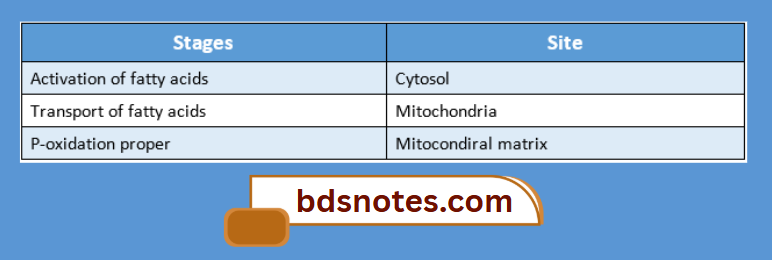
1. Fatty acid activation:
- It occurs in two steps.
- Fatty acid reacts with ATP to form acyl adenylate
- Acyladenylate combines with coenzyme A to produce acyl CoA.
- The enzyme involved in it is thiokinase or acyl CoA synthetases.
- In it, two high-energy phosphates are utilized.
- ATP is converted to pyrophosphate.
- Pyrophosphate is hydrolyzed to phosphate by inorganic pyrophosphatase.
Fatty acid + ATP → acyl adenylate
Acyladenylate + coenzyme A → acyl CoA
2. Transport of acyl CoA:
- And a group of acyl CoA is transferred to carnitine by carnitine acyltransferase I on the outer surface of the mitochondrial membrane.
- Next, this acyl-carnitine is transported across the membrane to the mitochondrial matrix.
- On the inner surface of the mitochondrial matrix, carnitine acyl transferase II converts acylcarnitine to acyl CoA.
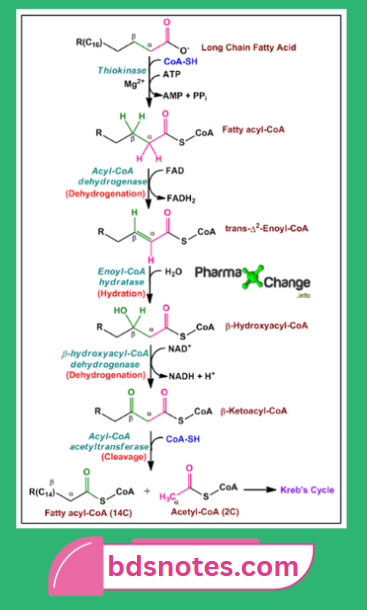
3. β-Oxidation proper:
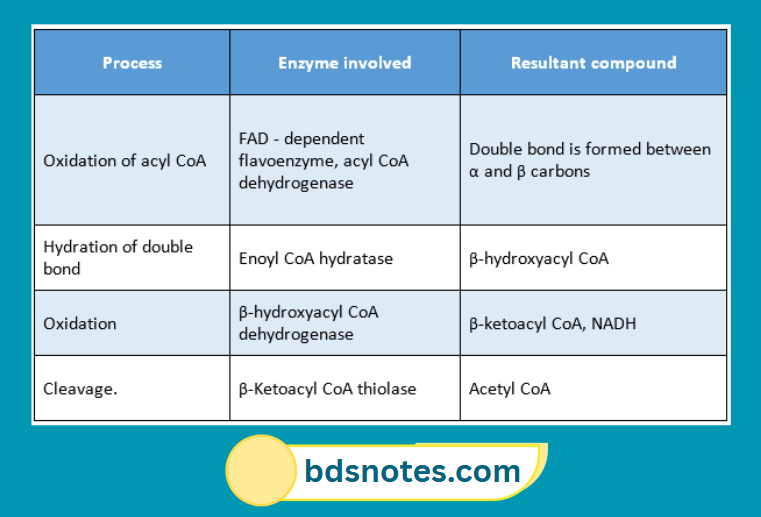
- The cycle continues till fatty acids are completely oxidized.
Energetics:
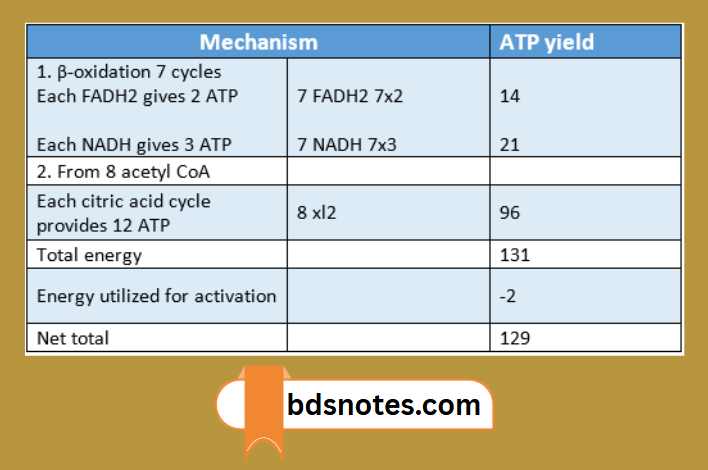
- Palmitoyl CoA undergoes 7 cycles of p-oxidation to yield 8 acetyl CoA.
- Actyl CoA can enter citric acid cycle.
Importance:
- It results in the removal of acetyl CoA.
- This acetyl CoA can enter into the TCA cycle.
- It occurs in most of the tissues in the body.
- It continues till the fatty acid is completely oxidized.
- It occurs predominantly in biological systems.
- Its main aim is to generate energy.
- It produces metabolic water which has great importance in animals like camels and kangaroo rats.
- Due to metabolic water, these animals can live for long periods even without food and water.
Leave a Reply