Mineralization Of Enamel
Write briefly about the mineralization of enamel.
Answer:
Mineralization of enamel:
“Understanding the mineralization of enamel through FAQs: Composition, functions, and uses explained”
- There occurs the immediate formation of crystallites within enamel proteins secreted first against mantle dentin.
- It is followed by its elongation against the ameloblast membrane at sites where enamel proteins are released.
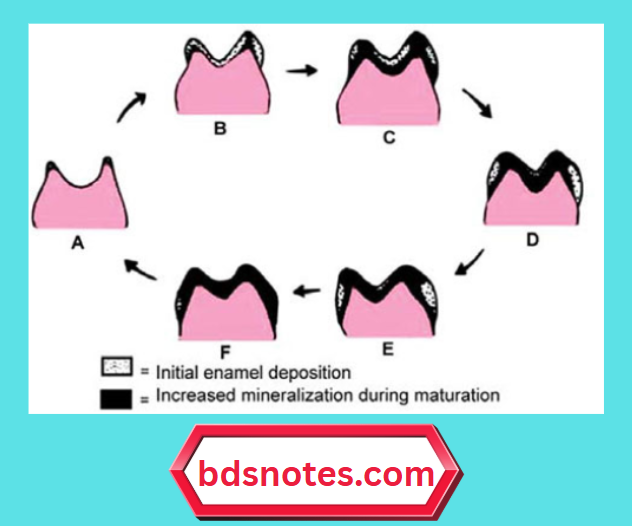
- Mineralization of enamel takes place in two stages.
- In the first stage, about 25-30% of mineralization occurs.
- Immediate partial mineralization occurs in the matrix segments and tire interprismatic substance.
- No matrix vesicles or unmineralized matrix is seen.
- The first mineral forms are crystalline apatite
- This is converted into hydroxyapatite.
- Maturation.
- It is a stage of gradual completion of mineralization.
- The maturation process progresses from crown height to the cervical area and forms the dentinal end of the rods to the surface.
- Growth of the crystals occurs.
- Tuftelin, an enamel protein participates in the nucleation of enamel crystals.
- Other enamel proteins bind the specific surfaces of the crystal and inhibit further deposition.
- The rate of formation of enamel is 4 pm/ day.
- It is more in permanent teeth than in deciduous teeth.
- The crystal further increases in size even after tooth eruption due to ion exchange with saliva.
- The organic matrix is gradually thinned out and widely spaced.
- Loss in the volume of the organic matrix is caused by the withdrawal of a substantial amount of protein as well as water.
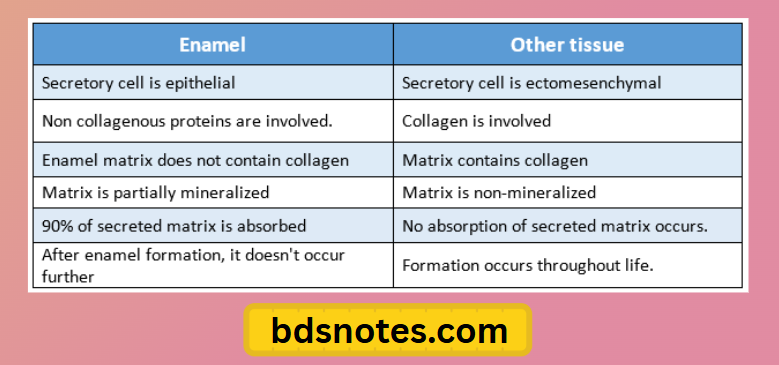
- The mineralization of enamel differs from that of other tissues.
- The difference is as follows.
- In the first stage, about 25-30% of mineralization occurs.
“Importance of studying the mineralization of enamel for dental students: Questions explained”
“Factors influencing success with mineralization of enamel studies: Q&A”
“Common challenges in mastering mineralization of enamel notes effectively: FAQs provided”
Leave a Reply