• Skip to main content
  • Skip to secondary menu
  • Skip to primary sidebar
  • About Us
  • Terms of Use
  • Privacy Policy
  • Disclaimer
  • Contact Us
  • Sitemap

BDS Notes

BDS notes, Question and Answers

  • Public Health Dentistry
  • Periodontics
  • Pharmacology
  • Pathology
  • Orthodontics
    • Anchorage In Orthodontics
    • Mandibular Growth, Functional Matrix
    • Retention and Relapse
  • General Surgery
    • Cysts: Types, Causes, Symptoms
    • Maxillofacial Fractures, Disorders, and Treatments
    • Lymphatic Disorders
    • Neurological and Facial Disorders
  • Temporal And Infratemporal Regions
    • Spinal and Neuroanatomy
  • Dental Materials
    • Dental Amalgam
Home » Pancreatic Secretions: Enzymes And Hormonal Regulation

Pancreatic Secretions: Enzymes And Hormonal Regulation

February 6, 2026 by Kristensmith Taylor Leave a Comment

Pancreatic Secretions: Enzymes And Hormonal Regulation

Name phase of gastric secretion and describe in detail. (or) Phases of gastric secretion.
Answer:

Phases of gastric secretion:

1. Cephalic phase:

  • Secretion of gastric juice by the stimuli arising from head region is called cephalic phase.
  • It occurs even before food enters the stomach.

Gastric Juice secreted:

  • Gastric juice secreted during this phase is rich in enzymes and hydrochloric acid.
  • 30-50% juice is secreted.

Regulation:

  • This phase is regulated by two reflexes.

1. Unconditioned reflex:
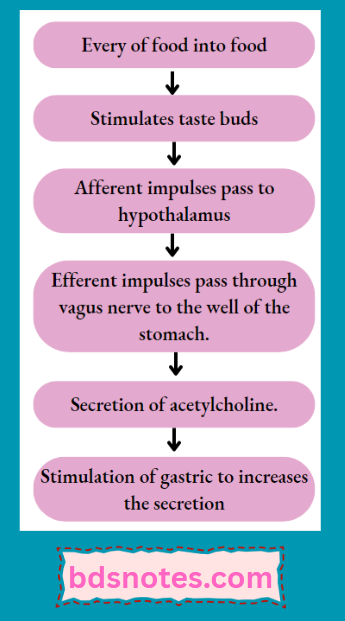
Taste Bud Stimulation And Gastric Secretion

Conditioned reflex.

It is stimulation of gastric juice via vagus nerve in response to sight, smell, thought or taste of the food.

2. Gastric phase:

  • Once the food enters the stomach, the secretion of gastric juice increases, this is called gastric phase.

Gastric juice secreted:

  • Gastric juice secreted during this phase is rich in pepsinogen and hydrochloric acid.
  • 50-60% of the total juice is secreted during this phase.

Regulation:

  • This phase is regulated by both nervous and hormonal mechanism.

3. Intestinal phase:

  • This phase occurs when food enters the duodenum.

Regulation:

  1. Initial phase.
    • As the food enters the intestine, it stimulates the duodenal mucosa to release gastrin.
    • This gastrin is transported to stomach where it stimulates the secretory activity of gastric glands.
  2. Later stage.
    • After the initial increase in secretion of gastric juice, there is decrease or complete stoppage of secretion of gastric juice.
    • This secretion is inhibited by.
      • Enterogastric reflex.
      • GI hormone.

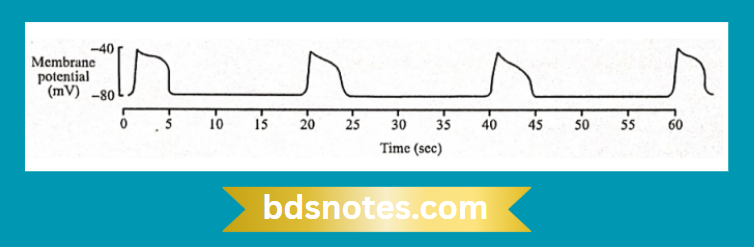
Basic Electrical Rhythm Of The Stomach

Filed Under: Anatomy

Reader Interactions

Leave a Reply Cancel reply

Your email address will not be published. Required fields are marked *

Primary Sidebar

Recent Posts

  • Branchial Cleft Cyst: Background, Pathophysiology, Etiology
  • Maxillary Nerve: Origin, Course, And Branches
  • The Father Of Anatomy And A Great Anatomist Herophilus
  • Bone Structure – Anatomy
  • The External Carotid Artery: Anatomy, Branches, And Functions
  • Occipitofrontalis Muscle
  • Superficial Temporal Artery
  • Platysma Muscle
  • Cartilage
  • Cauda Equina And Conus Medullaris Syndromes
  • Subcutaneous Injections And Device Management
  • Types Of Circulation: Pulmonary, Systemic, And Portal
  • Structure Of Skeletal Muscle
  • Elastic Cartilage
  • Cellular Organelles And Structure
  • The Golgi Apparatus – The Cell
  • The Cytoplasmic Inclusions Of Certain Plant Cells
  • Dental Abscess
  • Laser Surgery
  • Our Facial Muscles And Their Functions

Copyright © 2026 · Magazine Pro on Genesis Framework · WordPress · Log in