Important ENT Anatomy Notes: Pyriform Fossa and Mandible
Question 1. Significance of Pyriform fossa
Answer:
- Pyriform fossa lies between quadrate membrane & medial side of thyroid cartilage
- Pyriform fossa is transverse by internal laryngeal nerve
- Pyriform fossa is used to smuggle out precious stones, diamonds, etc
- Thus it is called smuggler’s fossa
- Tumours in it causes dysphagia
Question 2. Name the bones ossified in the membrane
Answer:
- Frontal Parietal
- Temporal
- Mandible
- Palatine
- Nasal
- Vomer
- Zygomatic
- Maxilla
Question 3. Name different types of sutural joints
Answer:
- Based on the structure of their articular surfaces, there are 5 types of sutural joints:
- Plane suture
- Squamous suture
- Serrate suture
- Denticulate suture
- Schindylesis
Question 4. Laws of ossification
Answer:
Ossification occurs by two processes
1. Endochondrial ossification
- Endochondrial ossification involves cartilage as precursor
- Example: healing of fractures treated with plaster of Paris
2. Intramembranous ossification
- Intramembranous ossification is direct laying down of bone into the primitive connective tissue
- Example: healing of fractures treated with open reduction and internal fixation
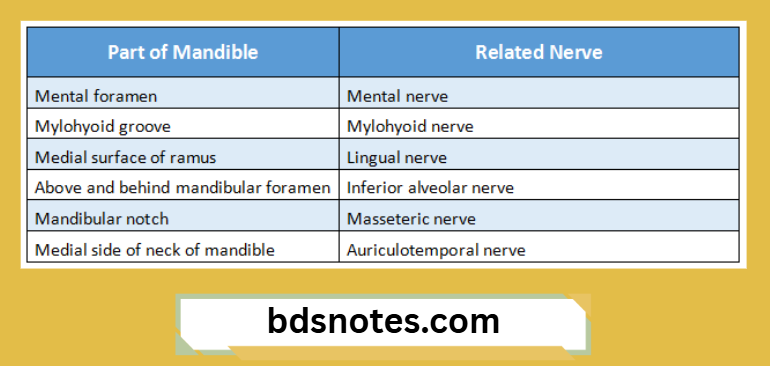
Question 5. Nerves related to mandible.
Answer:
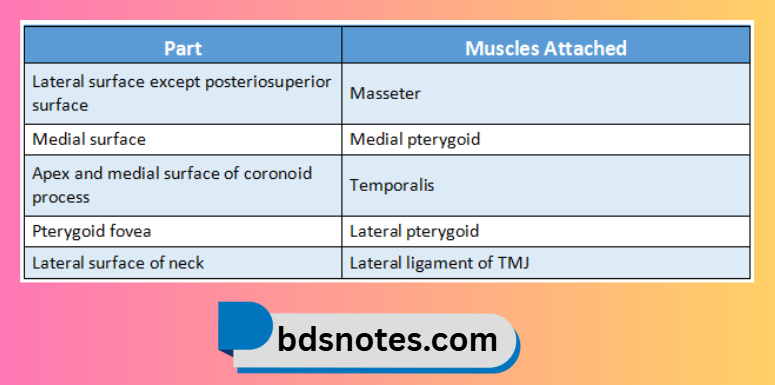
Question 6. Name any four muscles attached to ramus of mandible.
Answer:
Leave a Reply