• Skip to main content
  • Skip to secondary menu
  • Skip to primary sidebar
  • About Us
  • Terms of Use
  • Privacy Policy
  • Disclaimer
  • Contact Us
  • Sitemap

BDS Notes

BDS notes, Question and Answers

  • Public Health Dentistry
  • Periodontics
  • Pharmacology
  • Pathology
  • Orthodontics
    • Anchorage In Orthodontics
    • Mandibular Growth, Functional Matrix
    • Retention and Relapse
  • General Surgery
    • Cysts: Types, Causes, Symptoms
    • Maxillofacial Fractures, Disorders, and Treatments
    • Lymphatic Disorders
    • Neurological and Facial Disorders
  • Temporal And Infratemporal Regions
    • Spinal and Neuroanatomy
  • Dental Materials
    • Dental Amalgam
Home » Important Neurophysiology Questions: Synapse, Reflex, and Motor Neurons

Important Neurophysiology Questions: Synapse, Reflex, and Motor Neurons

February 6, 2026 by Kristensmith Taylor Leave a Comment

Important Neurophysiology Questions: Synapse, Reflex, and Motor Neurons

Question 1. Synpatic transmission. (or) Trace the lateral spinothalamic tract
Answer:
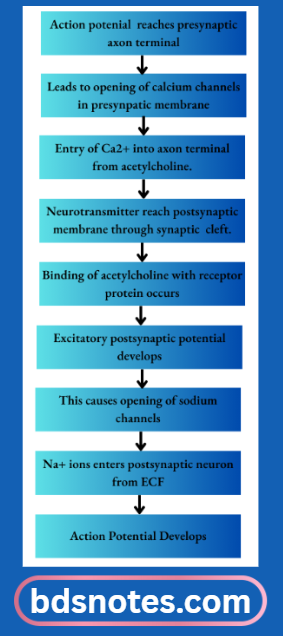
Action Potential Development

Question 2. Define reflex and write about reflex activity.
Answer:

Reflex:

  • It is an involuntary response to a stimulus which depends on integrity of reflex pathway.

Reflex activity:

  • It is a type of protective mechanism.
  • It protects the body from irreparable damages.

Examples:

1. When hand is placed one a hot object, it is withdrawn immediately.

2. When a very bright light is thrown into the eyes, eyelids are closed and pupils are constricted.

  • This prevents damage to retina.

Question 3. Lower motor neuron.
Answer:

  • Lower motor neuron are the anterior grey horn cells in the spinal cord and the motor neurons of the cranial nerve nuclei situated in brainstem.
  • They innervate the muscles directly.
  • They constitute the final common pathway of motor system.
  • Its action is under the influence of the upper motor neurons.

Lower motor neuron Types:

1. Alpha motor neuron.

  • Innervates extrafusal fibers of muscles and causes contraction of muscles.

2. Gamma motor neuron.

  • Innervates intrafusal fibers of muscles and maintains the muscle tone.

Filed Under: Anatomy

Reader Interactions

Leave a Reply Cancel reply

Your email address will not be published. Required fields are marked *

Primary Sidebar

Recent Posts

  • Branchial Cleft Cyst: Background, Pathophysiology, Etiology
  • Maxillary Nerve: Origin, Course, And Branches
  • The Father Of Anatomy And A Great Anatomist Herophilus
  • Bone Structure – Anatomy
  • The External Carotid Artery: Anatomy, Branches, And Functions
  • Occipitofrontalis Muscle
  • Superficial Temporal Artery
  • Platysma Muscle
  • Cartilage
  • Cauda Equina And Conus Medullaris Syndromes
  • Subcutaneous Injections And Device Management
  • Types Of Circulation: Pulmonary, Systemic, And Portal
  • Hierarchical Organization Of Skeletal Muscle Tissue
  • Elastic Cartilage Histology Short Note For Medical Exams
  • Cellular Organelles And Structure
  • The Golgi Apparatus – The Cell
  • The Cytoplasmic Inclusions Of Certain Plant Cells
  • Dental Abscess
  • Laser Surgery
  • Our Facial Muscles And Their Functions

Copyright © 2026 · Magazine Pro on Genesis Framework · WordPress · Log in