• Skip to main content
  • Skip to secondary menu
  • Skip to primary sidebar
  • About Us
  • Terms of Use
  • Privacy Policy
  • Disclaimer
  • Contact Us
  • Sitemap

BDS Notes

BDS notes, Question and Answers

  • Public Health Dentistry
  • Periodontics
  • Pharmacology
  • Pathology
  • Orthodontics
    • Anchorage In Orthodontics
    • Mandibular Growth, Functional Matrix
    • Retention and Relapse
  • General Surgery
    • Cysts: Types, Causes, Symptoms
    • Maxillofacial Fractures, Disorders, and Treatments
    • Lymphatic Disorders
    • Neurological and Facial Disorders
  • Temporal And Infratemporal Regions
    • Spinal and Neuroanatomy
  • Dental Materials
    • Dental Amalgam
Home » Physiology Of Cerebrospinal Fluid

Physiology Of Cerebrospinal Fluid

February 6, 2026 by Kristensmith Taylor Leave a Comment

Physiology Of Cerebrospinal Fluid

Crerebrospinal fluid [CSF].
Answer:

  • The fluid contained in the central canal of spinal cord, subarachnoid space and cerebral ventricles is known as cerebrospinal fluid.

Crerebrospinal fluid Properties:

  • It is clear, color less, transparent, alkaline fluid.
  • Specific gravity – 1,005 -1,008
  • It is almost protein free and cell free
  • Volume-130-150 ml.
  • Dialy secretion – 500-550 ml.
  • Rate of formation -0.2-0.3 ml/min.
  • Pressure-average – 130 mm H2O in lying position, 200 mm in sitting position.
  • pH – 7.33 (Alkaline)
  • Osmolaity – 289 m Os ml kg/water

Crerebrospinal fluid Composition:

1. Water 99.13%

2. Solids 0.87%

Central Nervous System crerebrospinal fluid

Crerebrospinal fluid Formation:

  • 50% by choroid plexuses in the ventricles.
  • 40% by blood vessels of meningeal and ependymis lining of ventricles.
  • 10% by blood vessels of brain and spinal cord.

Crerebrospinal fluid Circulation:
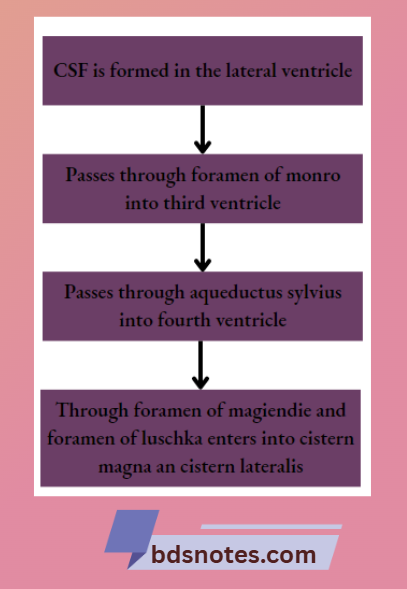
Lateral Ventricle CSF Flow

Crerebrospinal fluid Functions:

  • Protective function – CSF acts as buffer and protects brain from shock.
  • Acts as a reservoir to regulate the contents of cranium.
  • Helps to transfer waste products of brain into blood.
  • Serves as a medium for nutrient exchanges.

Filed Under: Anatomy

Reader Interactions

Leave a Reply Cancel reply

Your email address will not be published. Required fields are marked *

Primary Sidebar

Recent Posts

  • Branchial Cleft Cyst: Background, Pathophysiology, Etiology
  • Maxillary Nerve: Origin, Course, And Branches
  • The Father Of Anatomy And A Great Anatomist Herophilus
  • Bone Structure – Anatomy
  • The External Carotid Artery: Anatomy, Branches, And Functions
  • Occipitofrontalis Muscle
  • Superficial Temporal Artery
  • Platysma Muscle
  • Cartilage
  • Cauda Equina And Conus Medullaris Syndromes
  • Subcutaneous Injections And Device Management
  • Types Of Circulation: Pulmonary, Systemic, And Portal
  • Structure Of Skeletal Muscle
  • Elastic Cartilage
  • Cellular Organelles And Structure
  • The Golgi Apparatus – The Cell
  • The Cytoplasmic Inclusions Of Certain Plant Cells
  • Dental Abscess
  • Laser Surgery
  • Our Facial Muscles And Their Functions

Copyright © 2026 · Magazine Pro on Genesis Framework · WordPress · Log in