Pyramidal Tract Explained: From Brain To Spinal Cord
Describe pyramidal tract with the help of diagram from origin to termination. (or) Draw and label pyramidal pathway.
Answer:
Pyramidal tract:
- These are descending tracts concerned with voluntary activities of the body.
- They are also called corticospinal tracts.
- They are two such tracts.
- Anterior corticospinal tract.
- Lateral corticospinal tract.
- The fibres of this tract arises from pyramid like structure in the medulla, thus they are called pyramidal tracts.
Origin:
- Fibers of pyramidal tract arises from following.
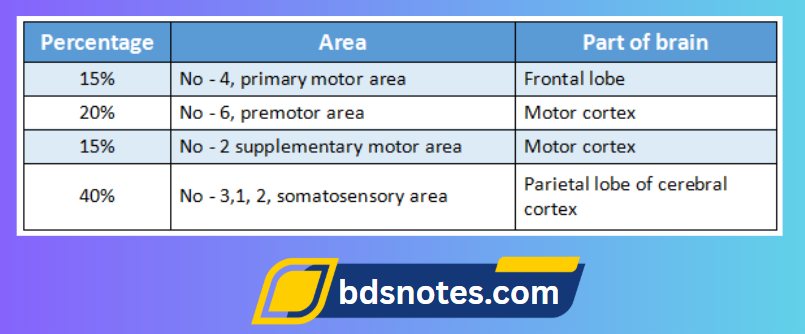
Course:
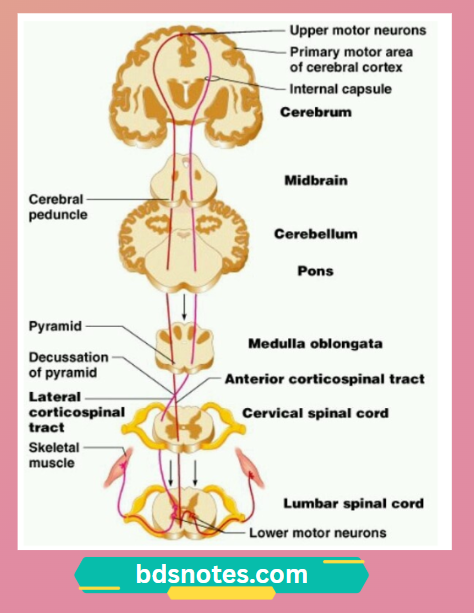
- The fibers of the pyramidal tract descend downwards, in diffused manner and then converge in the form of a fan like structure towards the brain stem as a radiating mass of fibers.
- This radiating mass is called corona radiata.
- Then, these fibers reach thalamus and descends down through.
1. Internal capsule:
- Here, it lie in the genu and anterior two-third of the posterior limb.
- Then, it enters mid-brain.
2. In midbrain:
- Here, it lie ventral to the substantia nigra.
3. In pons:
- Here, the fibers are broken up into a series.
- At the lower border of pons, the fibers are grouped once again.
4. In the medulla:
- The fibers occupies the most ventral part of the medulla.
- Here, the bundle of fibers gives an appearance of the pyramid.
- At the lower border of medulla, the pyramidal tract on each side is divided into 2 bundles of unequal sizes.
80% of fibers:
- Cross over and descend as the lateral corticospinal tract and end on the anterior horn cells.
- While crossing the midline, the fibers form the pyramidal decussation.
20% of fibers:
- Remain uncrossed
- Runs downwards in spinal cord as anterior corticospinal tract.
Termination:
- The fibers from both the tract terminate in the motor neurons of anterior grey horn.
- The axon of the anterior motor neurons leave the spinal cord as spinal nerves and supply the skeletal muscles.
Leave a Reply