Cardiac Muscle
Question 1. Structure of cardiac muscle
Answer:
- Cardiac muscle is involuntary, striated muscle
- The fibres are branched and interlock freely with each other
- Each is surrounded by a cell membrane called sarcolemma
- Intercalated discs occurs at the contact of two muscle fibres
- Gap junction is present in the intercalated discs along the sides of the adjacent myocardial cells
- The cardiac muscle fibres are highly vascular
- They are surrounded by a rich capillary network
- Sarcoplasmic reticulum shows plenty of cytoplasm, mitochondria and is rich in glycogen.
“Understanding cardiac muscle through FAQs: Structure, functions, and uses explained”
Question 2. Marey’s law
Answer:
- According to Marey’s law, the pulse rate is inversely proportional to blood pressure.
- The baroreceptors produce the Marey’s law only during resting conditions.
- During exercise there is an increase in both blood pressure and heart rate.
Question 3. Name any two factors that alter the heart rate
Answer:
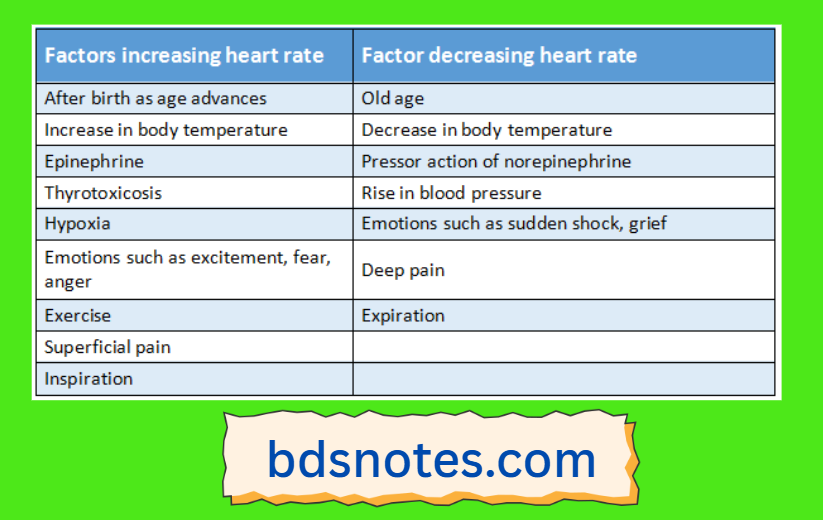
“Importance of studying cardiac muscle for medical students: Questions explained”
Question 4. P-R interval
Answer:
- PR interval is the interval from the beginning of P wave to the beginning of Q and R wave
- It denotes the time interval between the completion of atrial
depolarisation and beginning of ventricular depolarisation - It signifies the conduction of impulses through AV node
- It also indicates the duration of conduction of impulses from the SA node to ventricle
- It’s normal duration is 0.12-0.16 sec
- Duration decreases with increase in heart rate
- If duration is more than 0.2 sec it indicates delayed conduction and if it is less than 0.12 sec it indicates that impulse must have arise in AV node
“Common challenges in mastering cardiac muscle notes effectively: FAQs provided”
Question 5. Sinoaortic chemoreceptors
Answer:
Action of chemoreceptors:
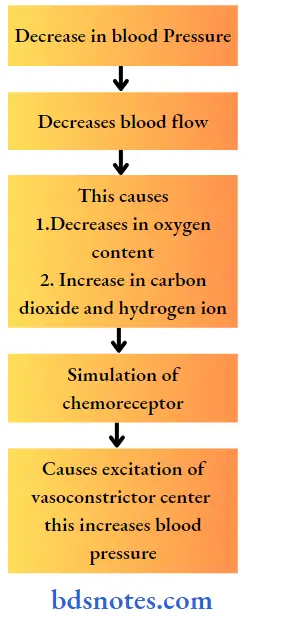
“Factors influencing success with cardiac muscle studies: Q&A”
Question 6. Baroreceptor reflex
Answer:
1. Action on increase in arterial blood pressure
- Increase in arterial blood pressure
- Causes stimulation of baroreceptors
- Impulses are send to nucleus of tractus solitarius
- This acts on
- Both normalizes the blood pressure
“Steps to explain the structure of cardiac muscle: Intercalated discs vs sarcomeres: Q&A guide”
2. Action on decrease in arterial blood pressure
- Decrease in arterial blood pressure
- Causes inhibition of baroreceptors
- This inhibits nucleus of tractus solitarius
- Acts on
Leave a Reply