Cardiac Output
What is cardiac output? Mention factors effecting cardiac output? Add a note on venous return. (or) Enumerate any three factors influencing venous return to the heart. Explain any one of them.
Answer:
Cardiac output:
- Definition:
- The amount of blood pumped out by each ventricle into the circulation per minute is called cardiac output.
“Understanding cardiac output through FAQs: Definition, functions, and uses explained”
Factors effecting cardiac output:
1. Venous return:
Venous return Definition:
- It is the amount of blood, which is returned to the heart from different parts of the body.
Effect on cardiac output:
- When venous return increases, cardiac output also increases.
- But when it decreases and heart rate also decreases then the cardiac output does not decrease.
- Venous return is directly proportional to cardiac output if other factors remains constant.
“Importance of studying cardiac output for medical students: Questions explained”
Factors effecting venous return:
- Thoracic pump or respiratory pump.
- During inspiration the following changes occur.
- Expansion of thoracic cavity.
- Decrease in intra-throacic pressure.
- Increase in diameter of inferior vena cava.
- This is turn increases venous return.
- During inspiration the following changes occur.
- Cardiac pump.
- Vis A tergo-A force from behind.
- It is imparted by the contraction of the heart.
- Vis A fronte-force acting from front.
- It attracts blood in the veins towards the heart.
- Vis A tergo-A force from behind.
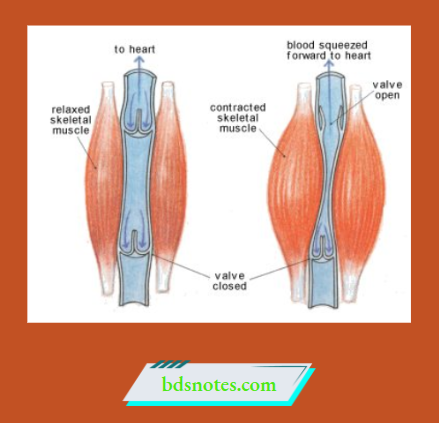
- Muscle pump:
- On contraction of muscle:
- Veins in between muscles are squeezed.
- The valves present proximal to the muscle is opened.
- This propels the blood towards heart.
- On relaxation of muscle.
- The valves proximal to the muscle is closed.
- This prevents back flow of blood.
- When muscular activity increases the venous return also increases.
- On contraction of muscle:
- Total blood volume.
- Increase in blood volume increases venous return.
- Sympathetic tone.
- Increase in sympathetic activity causes constriction of venules.
- This, the turn, increases venous return.
- Gravity.
- Gravitational force reduces the venous return.
- Venous pressure.
- Pressure in venules is 12-18 mm Hg.
- Pressure in inferior and superior venacava – 5.5 mmHG
- At the junction of vena cava and right atrium pressure is 4.6 mm Hg.
- Pressure in atrium falls to zero during atrial diastoles.
- This pressure gradient helps in venous return.
“Common challenges in mastering cardiac output notes effectively: FAQs provided”
2. Force of Contraction:
- The cardiac output is directly proportional to the force of contraction only if other factors remains constant.
- This in turn depends on diastolic period and ventricular filling.
3. Heart rate:
- It is directly proportional to cardiac output if other factors remains constant.
- Marked increase in heart rate, increases cardiac output.
- Marked decrease in heart rate, decreases cardiac output.
4. Peripheral resistance:
- It is the resistance against which the heart has to pump the blood.
- Thus, cardiac output is inversely proportional to peripheral resistance.
“Steps to explain cardiac output: Stroke volume vs heart rate: Q&A guide”
“Factors influencing success with cardiac output studies: Q&A”
Leave a Reply