Grids
Write short note on grid.
Answer.
Grid
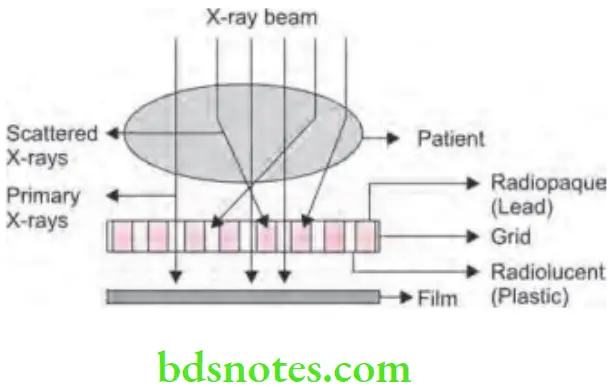
- These are devices which reduces the amount of scattered radiation reaching the film and still allowing the primary beam to reach the film.
- Thus, grid prevent scattered radiation which reduces fog and increases contrast.
“Understanding the role of grids in improving X-ray image quality: Q&A explained”
Grid Composition
A grid is composed of alternative strips of radiopaque and radiolucent material
- Radiopaque material is lead.
- Radiolucent material is plastic.
Potter-Bucky diaphragm
- The radiopaque material absorbs the scattered radiations while the radiolucent material allows passage of primary radiation.
“Early warning signs of issues caused by improper grid use: Common questions”
“Importance of studying grids for better diagnostic accuracy: Questions explained”
Types of Grid
Following are the grids used, i.e.
- Stationary grids and moving grids
- Focused grids and non-focused grids
Radiology grid Stationary Grids
Stationary grids do not move.
- Linear grid
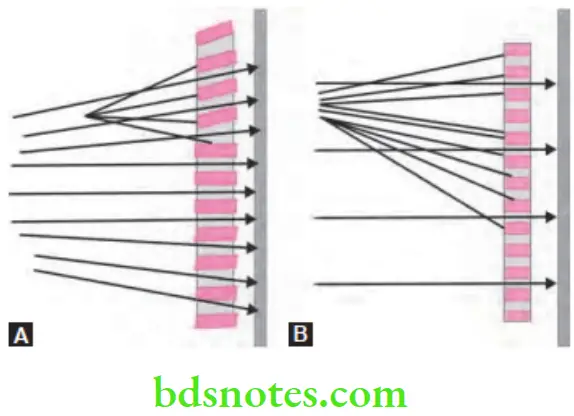
- In this, strips of lead are used which are placed strictly parallel to each other.
- Here the primary radiations travel radially from X-ray tube focal spot to the film will encounter the grid obliquely. So grid lines appear wider.
- While using the linear grid, cut-off of the beam may occur as some primary radiation can be absorbed by lead which is situated in peripheral region.
- For all practical applications, central beam in the plane is parallel with grid lines.
“Common challenges in using grids effectively in radiography: FAQs provided”
Stationary and moving grids in X-ray
- Focused grid
- Here strips of lead are angled progressively from center to the edge so the inter spaces are directed at the focal spot.
- Focused grid helps in prevention of primary cut-off.
- Focused grid minimizes the disadvantages of linear grid.
- Pseudo-focused grid
- Here the height of strips is reduced progressively from centre which leads to reduction in grid ratio from center to edge.
- Crossed grid
- Linear grids are placed mutually at the right angles so even the small amount of radiation is blocked.
“Asymptomatic vs symptomatic effects of ignoring proper grid protocols: Q&A”
X-ray grid
Moving Grids
- These grids move sideways across the film during the exposure.
- These grids reduce the white lead lines in the radiographic image.
“Steps to explain different types of grids: Focused vs parallel grids: Q&A guide”
“Role of high-ratio grids in minimizing scatter radiation: Questions answered”
Grid Advantages
Grids remove the scattered radiation efficiently which leads to decrease in film fog and increases radiographic contrast.
Focused grid radiology
Grid Disadvantages
- The radiopaque material (lead) may absorb some primary radiation and produces overall pattern of thin parallel white lines on the film called grid lines.
- The exposure time must be increased.
Leave a Reply