Biological Effects Of Radiation
Discuss in detail the biological effects of radiation on human tissue.
Answer. Biological effects of radiation are considered under the following headings:
Radiation On Human Tissue Classification 1
Somatic: The Effect of radiation that occurs in exposed individuals during their lifetime is known as the somatic effect. Except for the reproductive cells, all cells in the body are somatic cells. Biological effects of ionizing radiation are divided into two categories, i.e.
“Understanding the role of radiation in biological systems: Q&A explained”
- Stochastic effect: This effect includes the increase in probability of occurrence of biological effects with the increasing absorbed dose rather than its severity. They are the direct effect of dose.
- Non-stochastic effect or deterministic effect: In this effect severity increases with increase in the absorbed dose in affected individual.
Biological effects of radiation
“Importance of studying biological effects of radiation for better safety: Questions explained”
Genetic: It is the effect, which is manifested in future generation of exposed individuals. Reproductive cells are the genetic cells.
Radiation On Human Tissue Classification 2
- Acute or immediate effect: These are the effects which appear shortly after the exposure due to large dosage.
- Chronic or long-term effects: These effects get evident after a long period of time.
Radiation On Human Tissue Somatic Effects
Effect of radiation which occurs in exposed individuals during their lifetime is known as somatic effect.
“Common challenges in explaining biological effects of radiation: FAQs provided”
Somatic and genetic effects of radiation
Radiation On Human Tissue Somatic Stochastic Effect
- In these effects, probability of occurrence of change increases rather than the severity.
- Somatic stochastic effects are likely to occur and they are dose dependent.
- Threshold dose is no there for the stochastic effect.
- As body gets exposed to any amount of radiation, damaging effect can be induced.
- As low is the radiation dose less is the possibility of the cell to get damage.
- Example of this is radiation-induced cancer whose chances of occurrence increase due to greater exposure of a person or population to the radiation, this increases probability of cancer but not its severity.
Radiation On Human Tissue Non–Non-stochastic Effects
- These are the effects which increase the probability of occurrence with an increase in the radiation dose and consist of dose threshold below which the response cannot be seen.
- These effects occur specifically from high doses of radiation. An example is during radiotherapy procedure.
- Various other examples of non-stochastic effects are ulceration and desquamation of skin which leads to reddening of skin; damage to the connective tissue, blood vessels and glands; damage to alveolar bone; formation of cataract.
“Steps to explain different biological effects of radiation: Somatic vs genetic: Q&A guide”
Radiation On Human Tissue Genetic Effects
- These effects are not appreciated in the person irradiated but are transferred to future generations.
- Genetic cells are the germ cells of reproductive organs. These cells get damage even in the very small doses.
- Radiation lead to fragmentation of chromosome as well as mutation in the genes of sexual cells and the mutant genes are passed onto next generation. Mutation indicates the change in gene of a cell.
“Role of ionizing radiation in causing cellular damage: Questions answered”
- Due to mutation congenital abnormality in offspring of person irradiated may occur. Growth rate can also be diminished.
- Dose which causes doubling of all gene mutations is known as doubling dose.
- Damage can occur in any of the dominant or the recessive genes. Dominant effect is seen in the next generation while the recessive effect is seen after the several generations.
- Genetic damage is cumulative and is not repaired.
- Human embryo is most sensitive to radiation during 15–42 days of its term, so radiation is strictly avoided during the pregnancy.
- As human beings are exposed to heavy doses sterility occur in them.
- Beyond the age of reproduction, there is no genetic effect seen in human beings.
Radiation On Human Tissue Acute Effects
- Acute somatic effects are manifested in few hours to few days of acute irradiation and severity of effect depend on dose and dose rate.
- As per the latent period, effects are seen in minutes, days and weeks.
- Acute radiation effect is basically a short-term effect which occurs when large dose of radiation occur in short period of time, e.g. nuclear accident.
- These effects are not seen in dentistry as the diagnostic radiographs use 5 rad.
“Asymptomatic vs symptomatic effects of ignoring radiation risks: Q&A”
- Various examples of acute effects are:
- Skin: Excessive exposure can cause dermatitis. Repeated exposures leads to dryness of skin, erythema, thickening, desquamation and cracking of hands can also occur.
- Eyes: Radiation dose can lead to cataract and larger doses may detach retina.
- Nails: They get brittle, develop longitudinal fissures as well as ridges, finally nails get crumbled.
- Hair: Epilation of hairs occur by radiation. Hair loss can be permanent.
“Early warning signs of issues caused by radiation exposure: Common questions”
Genetic effects of radiation
Radiation On Human Tissue Chronic Effects
- Chronic effects occur due to low level of irradiation for long time or by chronic irradiation.
- These effects to be manifested take years, decades or generations.
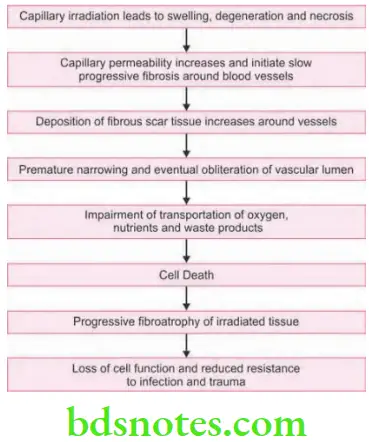
- Chronic effects depend on the extent of damage to the fine vasculature.
- Various examples of chronic effects are:
- Carcinoma: It is the earliest form of radiation-induced malignant tumor.
- Leukemia: It occurs due to primary or secondary radiation. Its incidence is seen in radiologists.
- Necrosis: It is commonly seen in the extracted socket after the radiation exposure.
Radiation On Human Tissue Pathogenesis of Chronic effect
Leave a Reply