Space Maintainers
“Space maintainer is a device used to maintain the space created by the loss of a deciduous tooth.”
Classification of Space Maintainers
According of Hitchcock
- Removable or fixed or semified.
- With a band or without a band.
- Functional or non-functional.
- Active or passive.
- Certain combinations of the above.
“Understanding the role of space maintainers in preventing dental issues: Q&A explained”
According to Raymond C.Thurow
- Removable.
- Complete arch.
- Lingual arch
- Extraoral anchorage.
- Individual tooth.
Read And Learn More: Mandibular Growth, Functional Matrix Theory & Space Maintainers in Orthodontics
“Importance of studying space maintainers for better pediatric outcomes: Questions explained”
According to Hinrichsen
- Fixed Space Maintainers.
Class 1:
- Nonfunctional types:
- Bar type
- Loop type.
- Functional type:
- Pontic type
- Lingual arch type.
- Nonfunctional types:
Class 2: Cantilever type (distal shoe, band and loop).
“Common challenges in using space maintainers effectively: FAQs provided”
- Removable Space Maintainers: Acrylic partial dentures.

“Steps to explain different types of space maintainers: Fixed vs removable: Q&A guide”
Ideal Requirements of Space Maintainer
- Space Maintainer should maintain the entire mesiodistal space created by lost tooth.
- Space Maintainer must restore the function and prevent over eruption of opposing teeth.
- Space Maintainer should be strong enough to withstand the functional forces.
- Space Maintainer should not exert excessive stress on adjoining teeth.
- Space Maintainer must permit maintenance of oral hygiene.
- Space Maintainer should be simple to construct.
- Space Maintainer must not restrict normal growth and development and natural adjustments which take place during the transition form deciduous to permanent dentition.
- The space maintainer should be come in the way of other functions.
Contraindications of Space Maintainer
- Mesiodistal width of underlying permanent tooth is less than space.
- When permanent tooth is near the crest of alveolar edge.
- When underlying permanent tooth is missing.
- Patient and parents are not interested.
- Oral hygiene maintenance is poor.
- Patient is mentally retarded.
“Role of band-and-loop space maintainers in pediatric dentistry: Questions answered”
Removable Space Maintainers
They are space maintainers which can be removed and reinserted into the oral cavity by the patient.
Space Maintainers Advantages
- Easy to clean and maintenance of oral hygiene.
- Space Maintainer allow time for circulation of blood to sof tissue.
- Space Maintainer serve other important functions like mastication, esthetics and phonetics.
- Space Maintainer stimulate eruption of permanent teeth.
- Space Maintainer either maintain or restore the vertical dimensions.
- Dental check up for detection of dental caries can be undertaken easily.
- Room can be given to permanent teeth to erupt without changing the appliance.
- Band construction is always not needed.
- Space Maintainer prevent developing of tongue thrusting habit inside the extraction space.
“Early warning signs of issues addressed by space maintainers: Common questions”
Space Maintainers Disadvantages
- Lost or broken by patient.
- Uncooperative patient not wear appliance.
- Lateral jaw growth may be restricted, if clasps are added.
- They can lead to irritation of underlying soft tissues.
Space Maintainers Indication
- When esthetic is important.
- When abutment teeth cannot support a fixed appliance.
- In cleft palate patient who need obturation of palatal defect.
“Asymptomatic vs symptomatic effects of ignoring space loss: Q&A”
Space Maintainers Contraindication
- When radiograph reveals that the unerupted permanent tooth is not going to erupt in less than 5 months of time, removable space maintainer can be given.
- If permanent teeth are not completely erupted, it can be difficult to adapt the bands. So it is advisable to use the removable space maintainer.
- In cases where multiple loss of deciduous tooth is required which may need functional replacement in form of either the partial or complete denture.
Commonly used Removable Space Maintainers
- Acrylic partial dentures.
- Acrylic full/complete denture.
- Removable distal shoe space maintainer.
Space Maintainer Fixed Space Maintainers
Following are the fixed space maintainers, i.e.
- Functional fixed space maintainers
- Crown and bar
- Band and bar
- Non-functional fixed space maintainers
- Band and loop
- Lingual arch
- Nance appliance
- Transpalatal arch
- Bonded space maintainer
- Cantilever type: Distal shoe
“Can targeted interventions improve outcomes with space maintainers? Answer provided”
Crown and Bar
- It is a functional space maintainer
- It is indicated in cases where there is loss of fist primary molar with significant loss of tooth material in abutment teeth.
- In its design proper sized stainless steel crown form is chosen for abutment teeth. Contour the stainless steel crown and fit them properly. Join abutment crowns by 0.036 inch stainless steel bar which is soldered to the crowns.
Nance Space Holding Appliance
- It is a non-functional passive type of fied space maintainer which is used in maxillary arch.
- Indicated for bilateral space maintenance.
- In its design it is a maxillary lingual arch which does not contact the anterior teeth. It also approximates anterior palate. Palatal portion incorporates an acrylic buttn which contacts the palate. Area of wire where acrylic is embedded is bent into various configurations for retention of acrylic.
“Steps to educate patients about space maintainers and their importance: Q&A format”
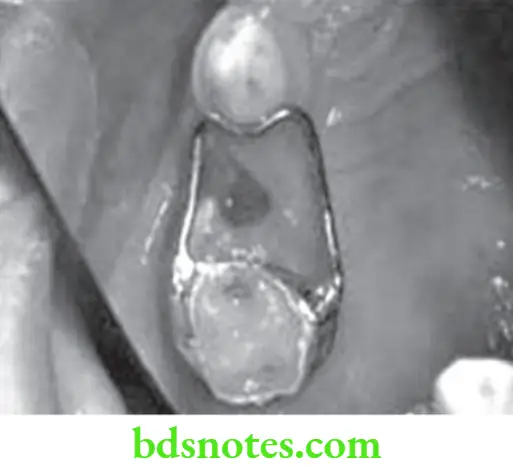
Distal Shoe Space Maintainer
- Distal shoe appliance is also known as intra-alveolar appliance.
- The distal surface of primary 2nd molar guides the unerupted 1st permanent molar.
- When the 2nd primary molar is removed prior to the eruption of the fist permanent molar, the intra-alveolar appliance provides greater control of the path of eruption of the unerupted tooth and prevents undesirable mesial migration.
- The appliance used now is Roche’s distal shoe.
“Differential applications of unilateral vs bilateral cases: Questions answered”
Leave a Reply