Management Of Class II Malocclusion
Discuss in brief the etiology, clinical features, cephalometric findings and the time of treatment in an Angle’s class II division 1 malocclusion case.
Answer.
Cephalometric Findings in Angle Class II div 1
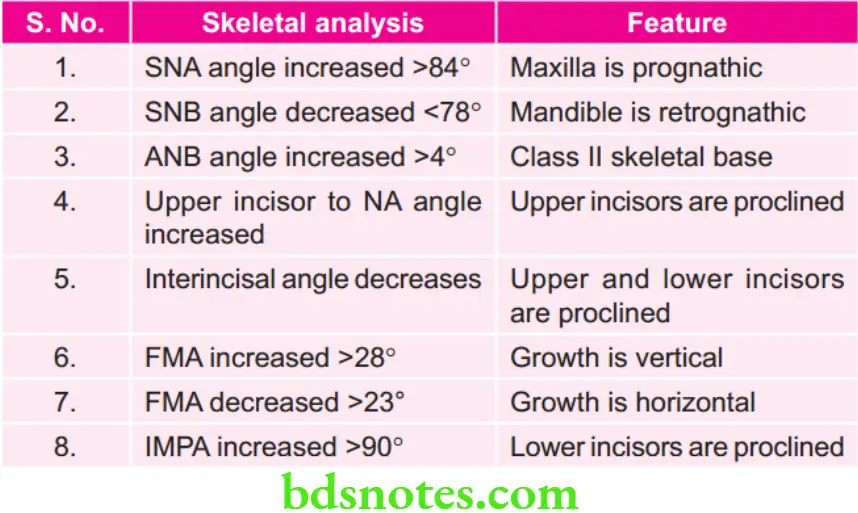
“Understanding the role of management in treating Class II malocclusion”
Soft Tissue Analysis
Lips may locate beyond the ‘S’ line and give common profile.
Time of Treatment in Angle’s Class 2, Div. 1 Malocclusion
There are three basic approaches to the treatment of class 2, div. 1, depends upon the time of treatment.
- Growth modification.
- Camouflge.
- Surgical correction.
“Importance of studying Class II malocclusion for better orthodontic outcomes”
Growth Modification
In this the abnormal skeletal patterns can be corrected by functional and orthodontic appliances to reduce the severity.
These treatment procedures are usually carried out during the mixed or rarely permanent dentition period prior to the a cessation of growth.
“Steps to explain different types of Class II malocclusion: Division 1 vs Division 2”
Camouflge
In patients who are beyond growth, it is not possible to undertake growth modification. Thus, the underlying skeletal discrepancy can be camouflged by orthodontic tooth movement.
This is obtained by extraction of certain teeth and moving rest of the teeth.
“Common challenges in managing Class II malocclusion effectively”
Surgical Correction
Done after the completion of growth, in patient exhibiting severe skeletal malocclusion.
Leave a Reply