Extractions In Orthodontics
Describe the criteria for therapeutic extraction in orthodontics.
Answer. Painless removal of teeth from its socket is termed as extraction.
- Extraction in orthodontia includes serial extraction carried out as an interceptive procedure during the mixed dentition period.
- Therapeutic extraction is carried out as a treatment procedure for gaining space.
“Understanding the role of extractions in orthodontic treatment”
Need for Extraction/Consideration of Extraction of Teeth in Orthodontics
Extraction of teeth as a part of orthodontic treatment may be required in the following circumstances.
Correction of the Crowding
- Crowding occur due to arch length and tooth material discrepancy, so prior to extraction a careful analysis of tooth size-arch length discrepancy is done.
- In many of the cases tooth material-arch length disproportion is not treated by increase in the arch length. So decrease of tooth material is the only alternative.
- In severe tooth material, arch length discrepancy extraction of one or more teeth should be undertaken to correct the malocclusion.
“Importance of studying extractions for better orthodontic results”
Correction of the Sagittal Interarch Relationship
Various cases of sagittal malrelationships such as Class 2 or Class 3 malocclusion may need extraction of teeth to achieve normal sagittal inter-arch relationship.
- In Angle’s Class 1 cases: Extractions should be carried out in both the arches.
- In Angle’s Class 2 cases: It is always possible to reduce the abnormal maxillary proclination by extracting only fist premolars in maxillary arch.
- In Angle’s Class 3 cases: It is always beneficial to avoid extraction in maxillary arch. They are preferably treated by extraction only in the lower arch or by the extraction in both the arches.
Abnormal Size and Form of the Teeth
Deformed teeth which interfere with normal occlusion necessitate their extraction to achieve the satisfactory occlusion. For example, macrodontia, severe hypoplastic teeth, dilacerations and abnormal crown morphology.
“Common challenges in performing extractions for orthodontic purposes”
Skeletal Jaw Malrelations
Surgical procedures along with the extractions may be needed to correct severe skeletal malrelationship of jaws which may not be satisfactorily treated by orthodontic appliances alone.
Preservation of Symmetry
Extractions can be undertaken to correct any of the asymmetry in the dental arches.
“Steps to explain different types of extractions in orthodontics”
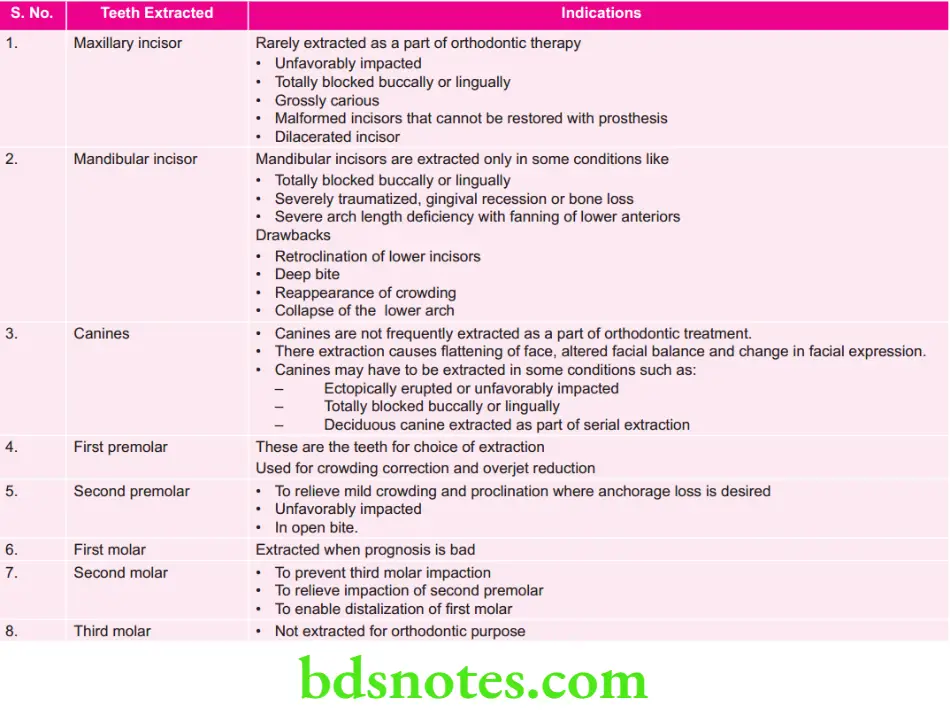
Choice of Teeth for Extraction
Choice of teeth to be extracted depends on local condition which includes:
- Direction and amount of jaw growth.
- Discrepancy between size of dental arches and basal arches.
- State of soundness, position and eruption of teeth.
- Facial profile.
- Degree of dentoalveolar prognathism.
- Age of patient.
- State of dentition as a whole.
“Role of premolar extractions in orthodontic treatment planning”
Leave a Reply