Role Of Oral Habits In The Development Of Malocclusion
Classify etiology of malocclusion. Describe in detail role of oral habits for developing the malocclusion.
Or
Classify the various factors in the etiology of malocclusion and write in detail the role of habits in causing malocclusion.
Or
Write about etiology of malocclusion.
Or
Write in detail on etiology of malocclusion.
Or
Briefly describe etiology of malocclusion.
Answer. Following are the classifications for etiology of malocclusion.
- Graber’s classification.
- Moyer’s classification.
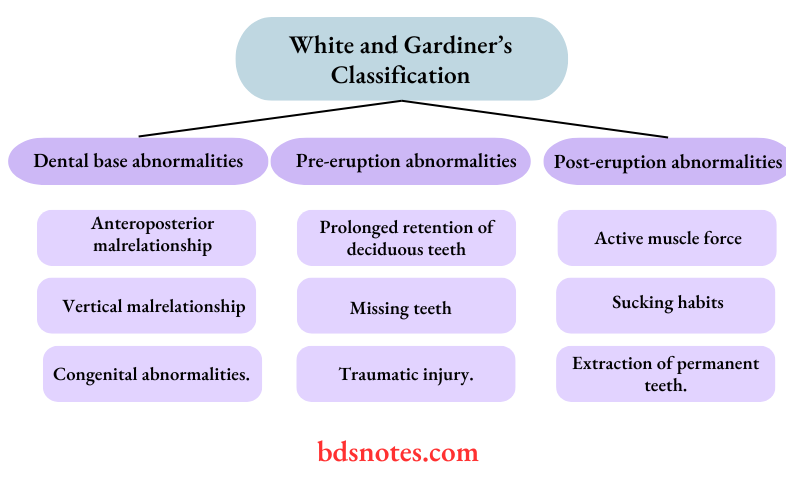
- White and Gardiner’s classification.
Graber’s Classification
General Factors
- Heredity
- Congenital
- Environmental
- Prenatal (Trauma, maternal diet, German measles etc.)
- Postnatal (Birth injury, cerebral palsy, TMJ injury)
- Predisposing metabolic climate and disease
- Endocrine imbalance.
- Metabolic disturbances.
- Infectious disease.
- Dietary problem (nutritional deficiency)
- Abnormal pressure habits and functional aberrations
- Abnormal sucking
- Thumb and finger sucking
- Tongue thrust and tongue sucking
- Lip and nail biting
- Abnormal swallowing habits
- Speech defects
- Respiratory abnormalities (Mouth breathing etc.)
- Tonsils and adenoids
- Psychogenic tics and bruxism
- Posture
- Trauma and accidents
Local Factors
- Anomalies of number of tooth
- Supernumerary teeth
- Missing teeth.
- Anomalies of tooth size
- Anomalies of tooth shape
- Abnormal labial frenum: Mucosal barriers
- Premature loss of deciduous teeth
- Prolonged retention of deciduous teeth
- Delayed eruption of permanent teeth
- Abnormal eruption path
- Ankylosis
- Dental Caries
- Improper dental restoration.
Moyer’s Classification
- Hereditary.
- Neuromuscular system
- Bone
- Teeth
- Soft tissues.
- Developmental defects of unknown origin.
- Trauma.
- Prenatal trauma and birth injuries
- Postnatal trauma.
- Physical agents.
- Premature extraction of primary teeth
- Nature of food.
- Habits.
- Thumb sucking and figer sucking
- Tongue thrusting
- Lip sucking and lip biting
- Posture
- Nail biting
- Other habits
- Diseases:
- Systemic diseases
- Endocrine disorders
- Local diseases.
- Nasopharyngeal diseases and disturbed respiratory function
- Gingival and periodontal diseases
- Tumors
- Caries.
- Malnutrition.
White and Gardiner’s Classification
Role of Oral Habits for the Development of Malocclusion
Thumb Sucking Habit
- It is the most commonly observed habit in children.
- Facial bones are not appropriately calcified in early childhood so sucking pressure between maxillary and mandibular teeth creates an abnormal developing force which leads to malocclusion.
Tongue Thrusting Habit
- In this the tongue is thrust between the upper and lower teeth during swallowing.
- This habit leads to the proclination of anteriors and anterior open bite.
- When tongue thrust between anterior teeth at that time posterior teeth become rendered out of occlusion due to which posterior teeth supraerupts and eliminate interocclusal clearance between lower and upper teeth. This causes open bite.
Mouth Breathing Habit
- Malocclusion associated with mouth breathing habit is known as long face syndrome.
- Width of the palate becomes narrow.
- Upper and lower incisors are retroclined.
- There is presence of anterior open bite and posterior crossbite.
- Due to flring of incisors there is increased overjet.
- As the forces between tongue and facial musculature get imbalanced this leads to constricted maxillary arch.
- All the above factors results in malocclusion due to mouth breathing habit.
Leave a Reply