Simon’s Classification Of Malocclusion
Name various classifications of malocclusion. Describe Simon’s classification giving its merits and demerits.
Or
Write briefly on Simon’s classification.
Or
Describe Simon’s classification.
Or
Write a short note on Simon’s classification of malocclusion
Answer. Various classifications of malocclusion:
- Angle’s system of classification.
- Dewey’s modification of Angle’s classification.
- Simon’s classification.
- Lischer modification of Angle’s classification.
- Bennett’s classification.
- Ackerman-Proffit system of classification.
“Understanding the role of Simon’s Classification in orthodontics: Q&A explained”
Simon’s Classification
- Simon give a craniometric classification of malocclusion that relate the dental arches in all the three planes.
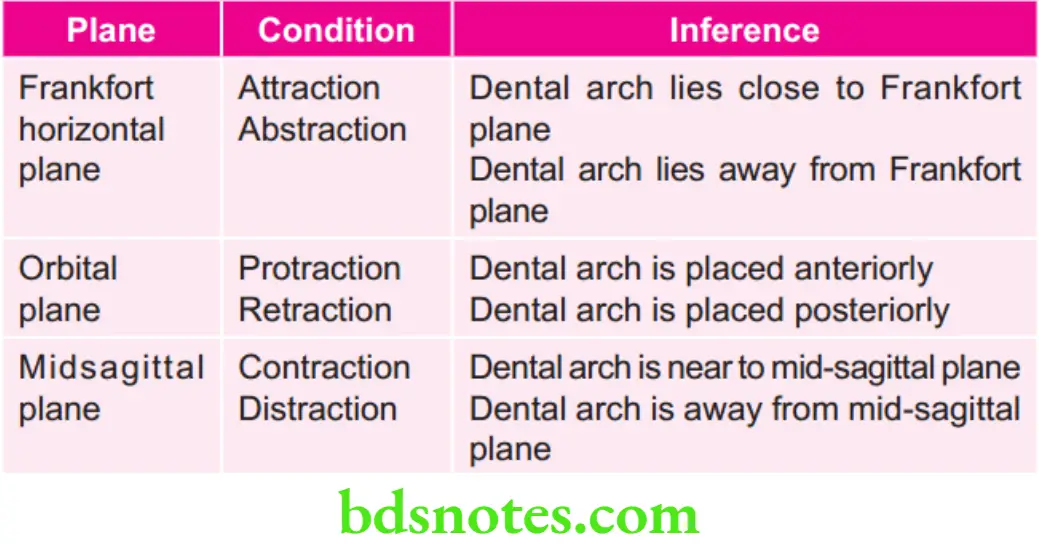
- Simon’s system of classification made use of three anthropometric planes, i.e. the Frank horizontal plane, the orbital plane and the mid-sagittl plane.
- Malocclusion is described as deviation of arches from their normal position in relation to three planes.
“Role of sagittal plane analysis in Simon’s Classification: Questions answered”
Frankfort Horizontal Planes(vertically) or EyeEar Plane
- This is a plane that connect the upper margin of the external auditory meatus to the infraorbital margin.
- This plane is used to classify malocclusion in a vertical plane.
- When the dental arch is closer to the normal Frankfort horizontal plane—Attraction.
- When the dental arch is further away from normal FH plane—Abstraction.
“Importance of studying Simon’s Classification for better orthodontic outcomes: Questions explained”
Orbital Plane (Anteroposteriorly)
- This plane is perpendicular to FH plane dropped down from the bony orbital margin directly under the pupil of eye.
- Used for anteroposterior plane.
- Simon’s law of canine—This plane connects infraorbital margin to distal of canine.
- If the arch is closer to the plane—Retraction.
- If the arch is further away from normal orbital plane—Protraction.
“Role of sagittal plane analysis in Simon’s Classification: Questions answered”
Midsagittal Plane or Raphae Median Plane
- This plane passes from midsagittal line.
- This is used to describe malocclusion in the transverse direction.
- When the arch is closer to the normal midsagittl plane—Contraction.
- When the arch is away from the midsagittal plane—Distraction.
“Common challenges in applying Simon’s Classification effectively: FAQs provided”
Demerits of Simon’s Classification
- It does not show that malocclusion is skeletal or dental.
- It does not show that malocclusion is one sided or on both side.
- It does not show abnormal position of one or more teeth (single/generalized).
- It does not differentiate that malocclusion is developmental or due to local factors.
Merits of Simon’s Classification
Simon had given the classification which is oriented to dental arch and to three different planes. This means that malocclusion is a three dimensional problem.
“Steps to explain different types of malocclusions in Simon’s Classification: Anterior vs posterior: Q&A guide”
Leave a Reply