Understanding Continuous, Interrupted, And Intermittent Orthodontic Forces
Define continuous, interrupted and intermittent orthodontic force. Describe pressure tension theory of tooth movement in detail.
Answer.
Continuous Orthodontic Force
It is defined as the force which is maintained at some appreciable fraction of original force between two successive visits of the patient.
Interrupted Orthodontic Force
It is defined as the force in which the level reduces to zero between two successive visits.
types of orthodontic forces
“Understanding the types of orthodontic forces”
Intermittent Orthodontic Force
It is defied as sudden drop of force to zero level when the orthodontic appliance is removed by the patient.
Pressure Tension Theory
- Whenever a tooth is subjected to the orthodontic force, it leads to the areas of pressure and tension.
- Areas of the periodontium in direction of tooth movement are under the pressure while area of periodontium opposite to tooth movement is under tension.
- According to Schwarz, areas of pressure show bone resorption while areas of tension show bone deposition.
“Treatment protocols for applying continuous forces”
“How do different orthodontic forces affect tooth movement?”
Biochemical Principles Involved in Orthodontic Tooth Movement
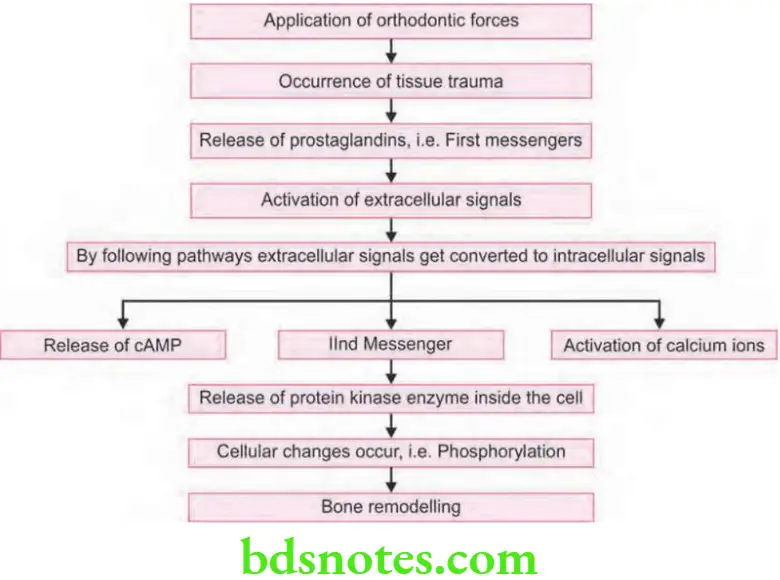
- As orthodontic force is applied on a tooth, it leads to number of biophysical events i.e. compression of periodontal ligament, bone deformation and tissue injury.
- Decrease in vascularity and overstretching of periodontal ligament leads to the chemical changes and inflmmatory response is elicited.
- Biophysical events cause various biochemical reactions at cellular level which causes release of some extracellular signaling molecules known as fist messengers.
- These consists of hormones such as parathormone, local chemical mediators i.e. prostaglandins, neurotransmitters such as substance P and vasoactive intestinal polypeptide.
Frontal Resorption In Orthodontics
First Messenger
- Prostaglandin is the fist messenger, mainly prostaglandin E leads to cellular diffrentiation.
- Other fist messengers are parathormone, substance P and vasoactive intestinal polypeptide.
- They all bind to the cell surface receptors and activate the extracellular signals.
“Role of force application in orthodontic treatment”
Release of Second Messenger
- Now the extracellular signal is converted to intracellular signal.
- Calcium ions and cAMP are the second messengers.
- Conversion occurs via two pathways, i.e. conversion of ATP into cyclic AMP and other is opening of calcium ion gated channel and activation of calcium ions.
- When continuous pressure is applied for 4 hours the second messenger get activated.
- So it is mandatory to wear any orthodontic appliance for 4 hours to produce effect.’
force systems in orthodontics
“Biomechanics of continuous vs interrupted orthodontic forces”
Release of Third Messenger
- Now cAMP and calcium ions act over protein kinase enzyme inside the cell.
- The protein kinase enzyme is the third messenger.
- Protein kinases cause cellular changes in form of phosphorylation.
- Phosphorylation leads to diffrentiation as well as activation of osteoblasts and osteoclasts which causes bony remodeling.
- As remodeling start tooth movements begin.
Question 15. Describe theories of tooth movement. Discuss histology of tooth movement.
Answer.
“Impact of interrupted forces on treatment duration”
Following are the accepted theories of tooth movement:
- Pressure tension theory by Schwarz (1932)
- Fluid dynamic theory or Blood flow theory by Bein
- Bone bending piezoelectric theory by Farrar (1876)
Leave a Reply