Water Quality Effects On Gypsum Die Properties
Describe its properties, water/powder ratio and setting expansion.
Or
Give the composition and properties of dental plaster.
Answer:
Gypsum is a mineral mined in various parts of the world. Gypsum is also an industrial by-product. Gypsum was fist found in mines around the city of Paris, so it is also called the “Plaster of Paris”.
- The mineral gypsum CaSO4. 2H2O is usually white to yellowish-white in color and is found as a compact mass.
- Products of gypsum are used extensively in dentistry.
Properties of Gypsum Products:
The following are the properties of gypsum materials:
- Strength
- Tensile strength
- Compressive strength
- Dimensional stability
- Hardness and abrasion resistance
- Porosity
- Reproduction of surface details
1. Strength:
- Strength of the set calcium sulfate dihydrate is dependent on the water/powder ratio, i.e. W/P ratio.
- The lesser is the W/P ratio, the greater is the strength
- W/P ratio is dependent on the type of hemihydrate particle.
- Type II gypsum (model plaster) has a higher W/P ratio than type IV gypsum (high-strength stone) and therefore less strength, because the hemihydrate particles in the plaster are more porous and irregular, and thus require more water for wetting than the dental stone.
Strength depends on the following factors, i.e.
- The material used whether calcined or autoclaved, and the additives used
- W/P ratio
- Vacuum mixing
The strength of gypsum increases rapidly as the material get harden after the initial settng time; moreover, free water content of set product affects the strength.
So this is the reason the two strength property of gypsum is reported as:
- Wet strength: It is the strength when water in excess of that required for hydration of the hemihydrate is left in the specimen. It is also known as green strength.
- Dry strength: It is the strength obtained when the excess of water has been driven of by drying. Dry strength may be two or more times higher than wet strength.
Removal of approximately 8.8% excess water in a cast will double the strength and hardness. The reason is the excess water adds mobility to the dihydrate crystals, so fier dihydrate crystals reinforce the larger dihydrate crystals as the water evaporates and thus strengthen the mass.
The drying process normally takes a week at normal room temperature and humidity which may be enhanced by increasing the temperature. But, this should be done with caution because as the cast is heated above 60°C, the water of hydration will also be driven of and the cast will be weakened.
2. Tensile Strength:
- Wet tensile strength of plaster is very low, i.e. 2 MPa.
- This is because of the porosity and brittle nature of the material. So, the teeth and margins of the model can be easily damaged if handled roughly.
- Dental stone has double the tensile strength as compared to plaster and is therefore preferred for the production of die material.
- Tensile strength is less than the compressive strength.
- Materials which are mixed with a high W/P ratio have lower tensile strength as compared to those mixed with a low W/ P ratio.
3. Compressive Strength:
- It is the mechanical property used for assessing the strength of gypsum products.
- Compressive strength values for dental plaster, dental stone, and die stone which are 12 MPa, 30 MPa, and 38 MPa, respectively.
- Mostly the compressive strength is affected by W/P ratio used. Reduction in the amount of water required to produce an acceptable mix results in significant improvement in compressive strength.
- Presence of voids decreases the compressive strength; so use of a vibrator is recommended for pouring the impression.
- To obtain a quick dry compressive strength and dry surface hardness, molds, casts, or dies are dried in an oven which dehydrates the gypsum leading in a reduction of strength.
4. Dimensional Stability:
- As material gets set, there is little or no significant dimensional change at room temperature.
- Set material should not be stored at high temperatures, i.e. between 90°C and 110°C.
- If the material is stored, the water of crystallization is removed and the dihydrate is converted back to hemihydrate which leads to the contraction of cast.
- As compared to a dental stone contraction of plaster is more and it also loses its strength.
- These contractions may occur during storage in air above room temperature.
- So, it is not safe to store or heat a stone cast in air at a temperature higher than 55°C.
5. Hardness and Abrasion Resistance:
- Hardness is related to compressive strength.
- The higher the compressive strength of the hardening mass, the higher the surface hardness.
- After the final setting occurs, the surface hardness remains practically constant until most of the excess water is dried, after which it increases.
- The surface hardness increases at a faster rate than the compressive strength since the surface of the hardened mass reaches a dry state earlier than the inner portion of the mass.
- Commercial hardening solutions are available to increase the surface hardness of stone.
- However, surface hardness and abrasion resistance are not always related, for example, epoxy resin is more abrasion resistant than die stone, even though die stone is harder of the two.
- Mixing high-strength dental stone with commercial hardening solutions containing colloidal silica improves the surface hardness of set gypsum.
- The use of die hardening solution does not necessarily improve the abrasive resistance as other factors too affect the abrasive resistance.
- The use of disinfectant chemicals on gypsum dies can cause surface erosion and affect the surface hardness.
6. Porosity:
- Increase in the W/P ratio causes a more porous set material.
- Plaster is more porous as compared to dental stone or die stone.
- This is due to the increase in W/P ratio used for the manipulation of plaster.
7. Reproduction of Surface Details:
- Types I and II gypsum products, i.e. impression plaster and model plaster reproduce a groove of 75 µm in width, while type III, IV, and V, i.e.
- Dental stone, die stone, and dental stone—high strength and high expansion reproduce a groove of 50 µm in width.
- Gypsum dies are not able to reproduce surface details, so epoxy or electroformed dies reproduce the surface details much better.
- Air bubbles are formed at the interface of impression and gypsum cast because freshly mixed gypsum does not wet some elastomeric impressions well.
- Incorporation of non–ionic surfactants improves the wetting of the impression.
- Use of vibration during the pouring of the cast reduces air bubbles.
- If the impression gets contaminated in which the gypsum die is poured by saliva or blood also affects the detail of reproduction.
- Rinsing the impression and blowing away the excess water improve the details recorded.
8. Water/Powder Ratio (W/P Ratio):
- Ratio of the required quantity of water for 100 mg of powder ,is known as the water/powder ratio.
- W/P ratio is a very important factor in deciding the physical and chemical properties of final product. It has also a pronounced effect on the setting time.
- So more is the water in the mix longer is the settling time?
- The strength of the gypsum is inversely proportional to W/P ratio. So W/P ratio should be kept low as possible but at the same time sufficient to produce a workable mix.
- Too low a water/powder ratio will produce a very thick consistency that may not flow in the finer detail of impression.
- The W/P ratio varies with the commercial brands of dental plaster or dental stone.
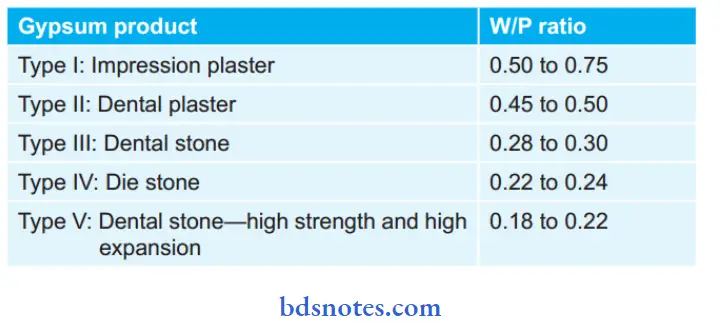
Various recommended W/P ratios of various gypsum products are:
Setting Expansion of Gypsum Products:
It is measured by using an extensometer. Setting expansion is of two types, i.e.
- Normal settng expansion
- Hygroscopic settng expansion.
- Normal Setting Expansion: All gypsum products show a linear expansion during setting due to the outward thrust of the growing crystals.
- Crystals growing from the nuclei not only intermesh but also intercept each other during growth.
- In dentistry, setting expansion may be both desirable and undesirable depending on the use.
It is undesirable in impression plaster, dental plaster, and stone as it will result in an inaccurate cast or change in the occlusal relation if used for mounting. - Increased setting expansion is desired in the case of investment materials as it helps to compensate for the shrinkage of the metal during casting.
- Control of Settng Expansion:
- Mechanical mixing reduces setting expansion when compared to hand mixed stone.
- An increase in W/P ratio reduces the setting expansion.
- Modifiers generally reduce the settng expansion.
- Potassium sulphate 4% solution reduces setting expansion from 0.5 to 0.06%.
- Sodium chloride and borax also decreases setting expansion.
- Hygroscopic Setting Expansion: When a gypsum product is placed under water before the initial set stage, a greater expansion is seen.
- This is due to hygroscopic expansion.
- When expansion begins, externally available water is drawn into pores forming in the setting mass and this maintains a continuous aqueous phase in which crystal growth takes place freely.
- Under dry conditions, this additional water is not available and as expansion occurs the aqueous phase in the mix is reduced to a fim over the growing crystals.
- It is greater in magnitude than normal setting expansion.
Leave a Reply