Understanding C-Factor in Composite Resin Polymerization
Write a short note on C-Factor.
Answer:
The magnitude of stress depends on the composition of the composite and its ability to flow before gelation occurs. This is influenced by the shape of the cavity and can be overcome by the way the dentist places the material into the cavity. This has been termed a configuration factor or C-factor.
- It is the ratio of bonded to unbonded surfaces.
C-Factor = \(\frac{\text { Bonded surface area }}{\text { Unbonded surface area }}\)
- The higher the ratio the more stress is potentially incorporated into the situation.
C-Factor in Different Tooth Preparations:
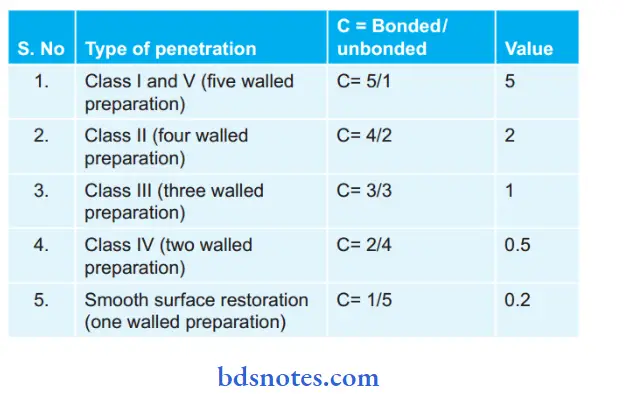
- For example, a Class I cavity with four walls and a pulpal floor will have a larger surface area that is bonded when compared to the occlusal surface area which will be unbounded.
- Similarly, a class V cavity with fixed internal surfaces also has a high C-factor.
- Cervical abrasive class V lesions have a saucer-shaped cavity design which will lower the C-factor significantly as the saucer shape is visualized as a single surface.
- As there is a small ratio of bonded to the free surface area, the flow of composite resin undergoes polymerization that occurs easily over the free area minimizing stress caused during the polymerization shrinkage.
- A relationship occurs between C-factor values and occlusal surface areas, larger is the occlusal surface area of restoration smaller is the C-factor.
- If the C-factor is more than 1, adhesion should not be maintained with conventional adhesives alone.
- In these cases, adhesive linings, different formulations of resin, and curing methods are used.
- The higher the C-value, the greater the polymerization shrinkage.
Leave a Reply