• Skip to main content
  • Skip to secondary menu
  • Skip to primary sidebar
  • About Us
  • Terms of Use
  • Privacy Policy
  • Disclaimer
  • Contact Us
  • Sitemap

BDS Notes

BDS notes, Question and Answers

  • Public Health Dentistry
  • Periodontics
  • Pharmacology
  • Pathology
  • Orthodontics
    • Anchorage In Orthodontics
    • Mandibular Growth, Functional Matrix
    • Retention and Relapse
  • General Surgery
    • Cysts: Types, Causes, Symptoms
    • Maxillofacial Fractures, Disorders, and Treatments
    • Lymphatic Disorders
    • Neurological and Facial Disorders
  • Temporal And Infratemporal Regions
    • Spinal and Neuroanatomy
  • Dental Materials
    • Dental Amalgam
Home » Mechanical Properties Of Dental Materials

Mechanical Properties Of Dental Materials

February 9, 2026 by Kristensmith Taylor Leave a Comment

Mechanical Properties Of Dental Materials

Write a short note on flexibility and resilience.
Answer:

Flexibility:

  • Generally in dental practice, the material used as a restoration should withstand high stresses and show
  • minimum deformation. However, there are instances where a large strain is needed with moderate or slight stress.
  • For example, in an orthodontic appliance, a spring is often bent a large distance with a small stress. In such a case material is said to be “flexible”.
  • The “minimum flexibility” is designed as the strain that occurs when the material is stressed to its proportional limit.

Resilience:

  • The term ‘resilience’ is associated with “springiness.” Resilience can be designed as the amount of energy absorbed by a structure when it is stressed not to exceed its proportional limit.
  • For example, when an acrobat falls on a trapeze net, the energy of his fall is absorbed by the resilience of the net, and when this energy is released. The acrobat is again thrown into the air.
  • The resilience of a material is usually measured in terms of its modulus of resilience which is the amount of energy stored in a body, when one unit volume of a material is stressed to its proportional limit.
  • Resilience is also measured by the area under the straight line portion of the stress-strain curve.
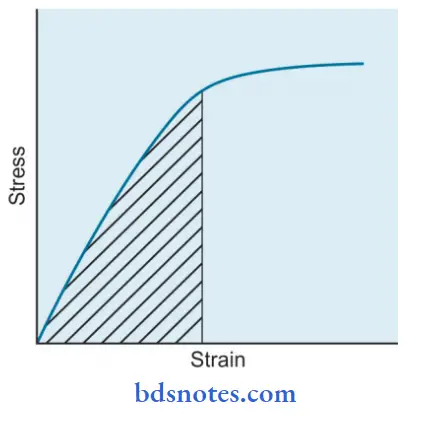
Structure and Properties of Dental Materials Area of resilience in a strain curve

Filed Under: Dental Materials

Reader Interactions

Leave a Reply Cancel reply

Your email address will not be published. Required fields are marked *

Primary Sidebar

Recent Posts

  • Branchial Cleft Cyst: Background, Pathophysiology, Etiology
  • Maxillary Nerve: Origin, Course, And Branches
  • The Father Of Anatomy And A Great Anatomist Herophilus
  • Bone Structure – Anatomy
  • The External Carotid Artery: Anatomy, Branches, And Functions
  • Occipitofrontalis Muscle
  • Superficial Temporal Artery
  • Platysma Muscle
  • Cartilage
  • Cauda Equina And Conus Medullaris Syndromes
  • Subcutaneous Injections And Device Management
  • Types Of Circulation: Pulmonary, Systemic, And Portal
  • Structure Of Skeletal Muscle
  • Elastic Cartilage
  • Cellular Organelles And Structure
  • The Golgi Apparatus – The Cell
  • The Cytoplasmic Inclusions Of Certain Plant Cells
  • Dental Abscess
  • Laser Surgery
  • Our Facial Muscles And Their Functions

Copyright © 2026 · Magazine Pro on Genesis Framework · WordPress · Log in