Ceramics And Metal-Bonded Ceramics
Write a short note on metal-ceramic restorations.
Answer:
It is also known as porcelain fused to metal or metal bonded restoration or ceramometal.
Composition of Porcelain Powder for Metal Ceramics:
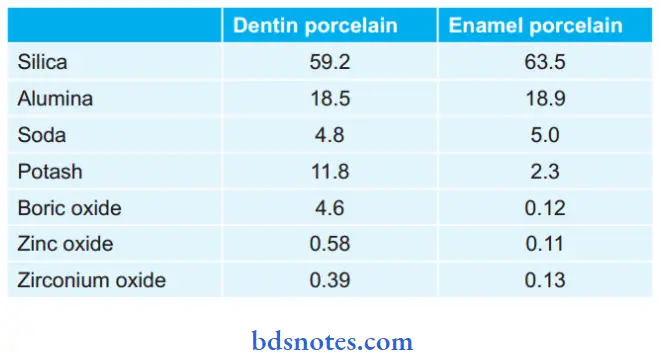
Types of Metal-ceramic Systems
As previously mentioned the metal-ceramic systems can be divided into:
- Cast metal-ceramic restorations:
- Cast noble metal alloys
- Cast base metal alloys
- Cast titanium:
- Swaged metal-ceramic restorations:
- Gold alloy foil coping
- Bonded platinum foil coping.
Technical Consideration of Metal Ceramic Restoration:
- Because of the high melting temperature of the alloy, phosphate or silica-bonded investment material must be used.
- A gas-oxygen flame or induction is generally employed for melting the alloy.
- Surface treatment of metal casting before porcelain application is important for good bonding.
- This treatment is used to toughen the casting and form surface oxides.
- The surface may be roughened by sandblasting with a fie alumina abrasive.
- In most cases, the metal casting is heat treated either in air or under a partial vacuum to produce surface oxide to improve bonding.
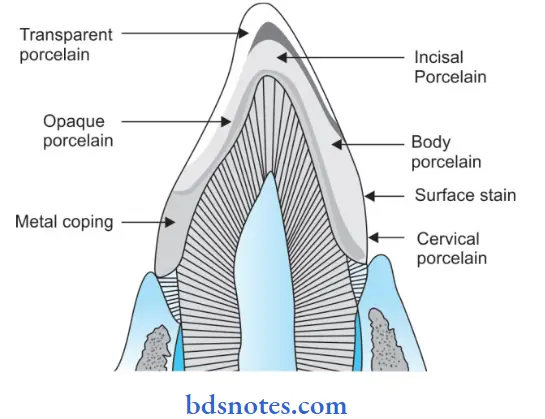
- The opaque porcelain is condensed with a thickness of approximately 0.1-0.2 mm.
- It is then fired, the translucent enamel is applied and tooth form is built. The unit is again fied.
- A final glaze is then obtained.
Uses of Metal Ceramic Restoration:
- Single anterior and posterior crowns
- Short and long span anterior and posterior FPDs.
Advantages of Metal Ceramic Restoration:
- If proper fabrication of metal-ceramic crowns is done they are stronger and more durable than all ceramic crowns.
- Long-span bridges can be done with an excellent fit.
- In metal-ceramic restoration, tooth preparation should be less as compared to all-ceramic restorations.
- Metal ceramic restorations withstand the forces of occlusion without wear.
- Metal ceramic restorations do not undergo staining along the interface between metal and ceramic veneer.
- Metal ceramic restoration is hard and resists wear extremely well.
- Metal ceramic restoration is compatible with soft tissues.
Disadvantages of Metal Ceramic Restoration:
- If an adequate shoulder margin is not present mainly in anterior teeth, achieving the aesthetic margin without a dark shadow of metal is difficult.
- Metal base can affect the aesthetic of porcelain which makes its appearance unnatural because of decreased light transmission.
- Patients are allergic to metal and alloys which warrant the use of metal-free ceramic.
- Due to aesthetic demands, patients are opting for All ceramic restoration.
- There is a high degree of shrinkage on firing.
- Along with time metal gets discolored.
- The appearance of translucency is difficult to produce.
Leave a Reply