• Skip to main content
  • Skip to secondary menu
  • Skip to primary sidebar
  • About Us
  • Terms of Use
  • Privacy Policy
  • Disclaimer
  • Contact Us
  • Sitemap

BDS Notes

BDS notes, Question and Answers

  • Public Health Dentistry
  • Periodontics
  • Pharmacology
  • Pathology
  • Orthodontics
    • Anchorage In Orthodontics
    • Mandibular Growth, Functional Matrix
    • Retention and Relapse
  • General Surgery
    • Cysts: Types, Causes, Symptoms
    • Maxillofacial Fractures, Disorders, and Treatments
    • Lymphatic Disorders
    • Neurological and Facial Disorders
  • Temporal And Infratemporal Regions
    • Spinal and Neuroanatomy
  • Dental Materials
    • Dental Amalgam
Home » Zoe -Zinc Oxide Eugenol

Zoe -Zinc Oxide Eugenol

April 23, 2025 by Kristensmith Taylor Leave a Comment

Zoe -Zinc Oxide Eugenol

Describe the Zinc Oxide Eugenol Cement.
Answer:

These cements are of low strength, are the least irritating of all dental cement, and have an obtundent effect on dentin.

Composition of  Zinc oxide eugenol cement.

Powder:
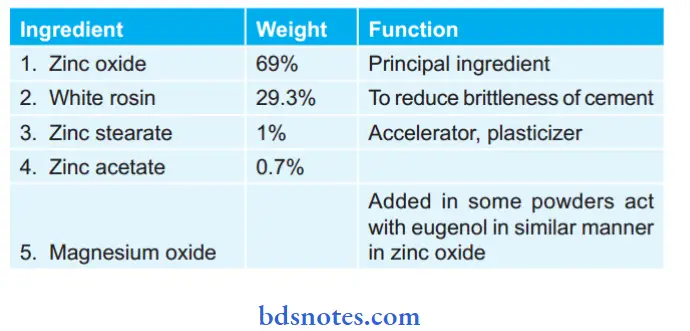
Dental cement Zinc Eugenol Cement Powder

“Understanding ZOE through FAQs: Composition, properties, and uses explained”

Liquid:
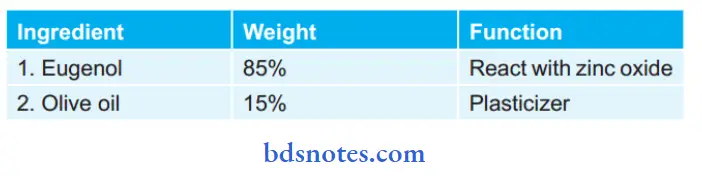
Dental cement Zinc Eugenol Cement liquid

Setting Reaction of Zinc oxide eugenol cement:

The setting reaction and microstructure are the same as that of ZOE impression paste.

In the first reaction hydrolysis of zinc oxide to its hydroxide takes place. Water is essential for reaction.

ZnO   +   H2O   →   2O  Zn (OH)2

“Common challenges in mastering ZOE effectively: FAQs provided”

The reaction proceeds as a typical acid-base reaction

Zn (OH)2  +   2HE    →    ZnE2  +  2H2O
Base      Acid            Salt
(Zinc     (Eugenol)    (Zinc eugenolate)
hydroxide)

The chelate formed is an amorphous gel that tends to crystallize imparting strength to the set mass.

“Importance of studying ZOE for dental professionals: Questions explained”

Manipulation of Zinc oxide eugenol cement:

The powder/liquid ratio is 4: 1 to 6: 1 by weight.

  • The bottoms are shaken gently.
  • A measured quantity of powder on liquid is dispensed onto a cool glass slab.
  • The bulk of the powder is incorporated into liquid and is spatulated thoroughly in a circular motion with stiff bladed stainless steel spatula
  • Small increments are then added until the mix is complete.

Filed Under: Dental Materials

Reader Interactions

Leave a Reply Cancel reply

Your email address will not be published. Required fields are marked *

Primary Sidebar

Recent Posts

  • Branchial Cleft Cyst: Background, Pathophysiology, Etiology
  • Maxillary Nerve: Origin, Course, And Branches
  • The Father Of Anatomy And A Great Anatomist Herophilus
  • Bone Structure – Anatomy
  • The External Carotid Artery: Anatomy, Branches, And Functions
  • Occipitofrontalis Muscle
  • Superficial Temporal Artery
  • Platysma Muscle
  • Cartilage
  • Cauda Equina And Conus Medullaris Syndromes
  • Subcutaneous Injections And Device Management
  • Types Of Circulation: Pulmonary, Systemic, And Portal
  • Structure Of Skeletal Muscle
  • Elastic Cartilage
  • Cellular Organelles And Structure
  • The Golgi Apparatus – The Cell
  • The Cytoplasmic Inclusions Of Certain Plant Cells
  • Dental Abscess
  • Laser Surgery
  • Our Facial Muscles And Their Functions

Copyright © 2026 · Magazine Pro on Genesis Framework · WordPress · Log in