Calcium Hydroxide
Calcium hydroxide is a relatively weak cement. Due to its alkaline nature, it also serves as a protective barrier against irritants from certain restorations.
Applications / Uses of Calcium hydroxide:
- For direct and indirect pulp capping.
- As low-strength bases-beneath silicate and composite restorations for pulp protection.
- Apexification procedure in young permanent teeth where root formation is incomplete.
- Used as a liner.
“Understanding calcium hydroxide uses through FAQs: Pulp capping, root canal therapy, and more explained”
Composition of Calcium hydroxide:
Base Paste:
- Glycol salicylate—40%
- Calcium sulfate
- Titanium dioxide—inert fillers, pigments
- Calcium tungstate or barium sulfate—provides radioopacity
Catalyst Paste of Calcium hydroxide:
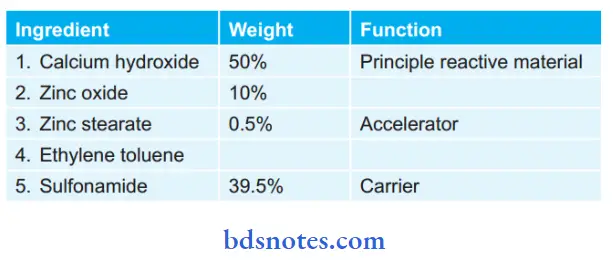
“Importance of studying calcium hydroxide for dental professionals: Questions explained”
Setting Reaction of Calcium Hydroxide:
Calcium hydroxide reacts with l-methyl trimethylene salicylate ester to form a chelate viz. amorphous calcium salicylate. Zinc oxide also takes part in this reaction.
Ca(OH)2+ l-methyl trimethylene salicylate → calcium salicylate
Uses Of Calcium Hydroxide In Dentistry
“Steps to explain calcium hydroxide uses: Pulp capping vs root canal therapy vs apexification: Q&A guide”
Properties Calcium hydroxide: Calcium hydroxide cements have poor mechanical properties.
- Mechanical Properties:
- Compressive strength: 10-27 MPa after 24 hours.
- Tensile strength: 1 MPa is low.
- Modulus of elasticity: 0.37 GP
- Thermal Properties: If used in sufficient thick layers they provide some thermal insulation.
- Solubility and Disintegration: The solubility in water is high 0.4 to 7.8%.
“Factors influencing success with calcium hydroxide knowledge: Q&A”
- Biological Properties:
- Effect on pulp: The cement is alkaline in nature. The high pH is due to the presence of free Ca (OH)2 in the set cement. The pH ranges from 9.2 to 11.7.
- Formation of secondary dentine: The high alkalinity and its consequent antibacterial and protein lysing effect help in the formation of reparative dentine.
Leave a Reply