Zinc Polycarboxylate
Explain cavity varnishes, liners, and cement bases. State their various uses. Give composition properties, manipulation, and uses of zinc polycarboxylate cement.
Or
Write a short note on zinc polycarboxylate cement.
“Understanding zinc polycarboxylate materials through FAQs: Composition, properties, and uses explained”
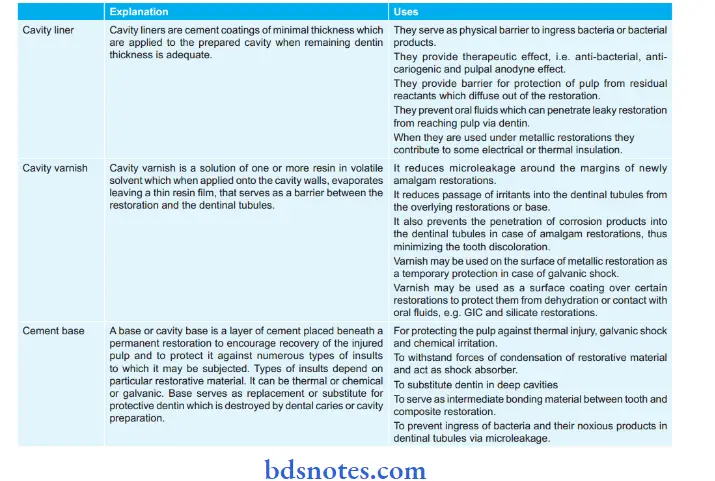
Zinc Polycarboxylate Cement:
- Polycarboxylate cement: Polycarboxylate cement was the first system developed with the potential for adhesion to the tooth structure.
Composition of Zinc Polycarboxylate Cement:
Powder:
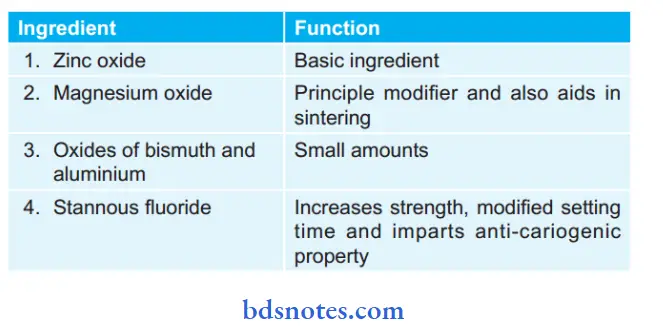
“Importance of studying zinc polycarboxylate materials for dental professionals: Questions explained”
Liquid:
- Aqueous solution of 32 to 42% of polyacrylic acid.
- The copolymer of acrylic acid with other unsaturated carboxylic acids, i.e. iticonic acid, maleic acid, or tricarballylic acid.
Manipulation of Zinc Polycarboxylate Cement:
- Conditioning: The tooth structure should be clean for proper bonding, for conditioning 10% polyacrylic acid solution followed by rinsing water or 1 to 3% hydrogen peroxide may be used. Then dry and isolate the tooth.
- Proportioning: 1.5 parts of powder to 1 part of liquid by wt.
- Procedure: The powder and liquid are taken on a cooled glass The powder is incorporated into the liquid in bulk (90%) with a stiff cement spatula and the remaining powder is added to adjust the consistency. The mix appears
quite thick, but this cement will flow readily into a thin film when seated under pressure.
“Common challenges in mastering zinc polycarboxylate knowledge effectively: FAQs provided”
Properties of Zinc Polycarboxylate Cement:
Mechanical properties:
- Compressive strength: 55 MP inferior to zinc phosphate cement.
- Tensile strength— 6.2 MP It is slightly higher than zinc phosphate cement.
- Solubility and disintegration: It tends to absorb water and is slightly more soluble (0.6% wt) than zinc phosphate cement.
- Biocompatibility: Pulmonary response is mild. The pH of this cement rises more rapidly than phosphate cement.
- Adhesion: This cement bonds chemically with the tooth structure. The carboxyl group in polymer molecules chelates with calcium in the tooth structure. Bond strength to enamel is 3.4 to 13.1 MPa and to dentine is 2.07 MP
- Optical properties: They are very opaque due to large quantities of unreacted zinc oxide.
- Thermal properties: They are good thermal insulators.
“Factors influencing success with zinc polycarboxylate selection: Q&A”
Uses of Polycarboxylate Cement:
- Primarily for luting permanent restorations.
- As bases and liners.
- Used in orthodontics for the cementation of bands.
- Also used as root canal filings in endodontics
Leave a Reply