• Skip to main content
  • Skip to secondary menu
  • Skip to primary sidebar
  • About Us
  • Terms of Use
  • Privacy Policy
  • Disclaimer
  • Contact Us
  • Sitemap

BDS Notes

BDS notes, Question and Answers

  • Public Health Dentistry
  • Periodontics
  • Pharmacology
  • Pathology
  • Orthodontics
    • Anchorage In Orthodontics
    • Mandibular Growth, Functional Matrix
    • Retention and Relapse
  • General Surgery
    • Cysts: Types, Causes, Symptoms
    • Maxillofacial Fractures, Disorders, and Treatments
    • Lymphatic Disorders
    • Neurological and Facial Disorders
  • Temporal And Infratemporal Regions
    • Spinal and Neuroanatomy
  • Dental Materials
    • Dental Amalgam
Home » Alloys Used In Dentistry

Alloys Used In Dentistry

April 26, 2025 by Kristensmith Taylor Leave a Comment

Alloys Used In Dentistry

Classify dental casting alloys. Give the properties of each constituent.
Or
Describe briefly about types of alloys used in dentistry.
Answer:

Alloy: An alloy is defined as a metal containing two or more elements, at least one of which is metal, and all of which are mutually soluble in the molten state.

Dental Alloys Types

Read And Learn More: Dental Materials Question And Answers

“Understanding alloys used in dentistry through FAQs: Types, properties, and applications explained”

Classification of Dental Casting Alloys:

  1. According to use:
    • Alloy for all metal and resin veneer restorations.
    • Alloys for metal-ceramic restoration
    • Alloys for removable dentures.
  2. According to yield strength and percentage elongation:
    • Type I: Soft
    • Type II: Medium
    • Type III: Hard
    • Type IV: Extra hard.
  3.  According to nobility:
    • High noble metal alloy − containing >40% Au and > 60 wt. % of noble metals.
    • Noble metal alloys contain>25 wt% % of noble metals.
    • The predominantly base metal alloy contains < 25 wt% %  of noble metals.
  4. According to major elements:
    • Gold alloy
    • Silver alloy
    • Palladium alloy
    • Nickel alloy
    • Cobalt alloy
    • Titanium alloys.
  5. According to the three major elements:
    • Gold-palladium-silver
    • Palladium-silver-tin
    • Nickel-chromium-molybdenum
    • Cobalt-chromium-molybdenum
    • Iron-nickel-chromium
    • Titanium-aluminium-vanadium.
  6. According to the number of alloys present:
    • Binary—two elements
    • Ternary—three elements
    • Quaternary—four elements.

Dental Casting Alloys

“Importance of studying dental alloys for dental professionals: Questions explained”
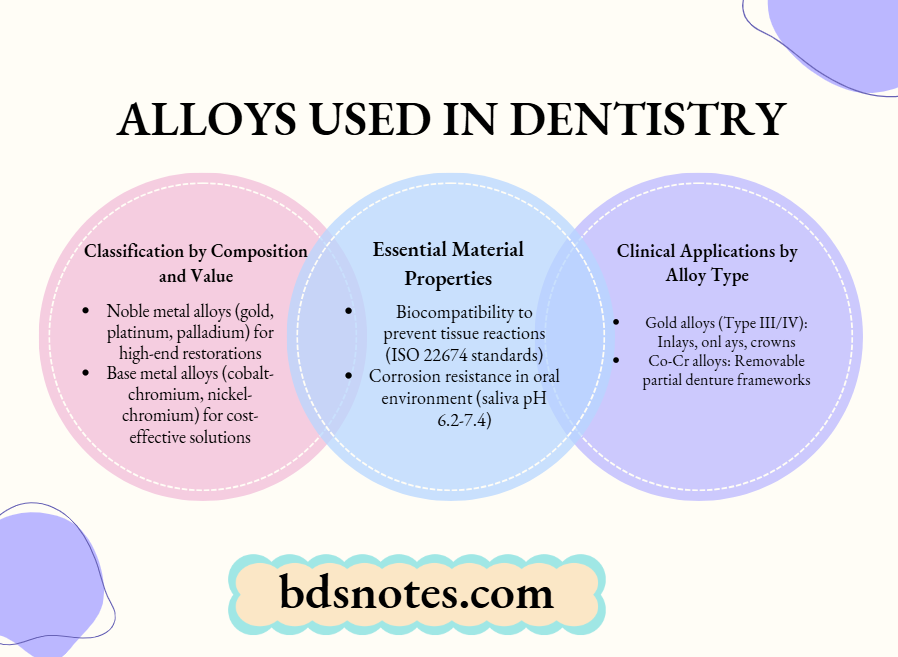
Alloys Used In Dentistry

“Common challenges in mastering dental alloys effectively: FAQs provided”

Filed Under: Dental Materials

Reader Interactions

Leave a Reply Cancel reply

Your email address will not be published. Required fields are marked *

Primary Sidebar

Recent Posts

  • Branchial Cleft Cyst: Background, Pathophysiology, Etiology
  • Maxillary Nerve: Origin, Course, And Branches
  • The Father Of Anatomy And A Great Anatomist Herophilus
  • Bone Structure – Anatomy
  • The External Carotid Artery: Anatomy, Branches, And Functions
  • Occipitofrontalis Muscle
  • Superficial Temporal Artery
  • Platysma Muscle
  • Cartilage
  • Cauda Equina And Conus Medullaris Syndromes
  • Subcutaneous Injections And Device Management
  • Types Of Circulation: Pulmonary, Systemic, And Portal
  • Structure Of Skeletal Muscle
  • Elastic Cartilage
  • Cellular Organelles And Structure
  • The Golgi Apparatus – The Cell
  • The Cytoplasmic Inclusions Of Certain Plant Cells
  • Dental Abscess
  • Laser Surgery
  • Our Facial Muscles And Their Functions

Copyright © 2026 · Magazine Pro on Genesis Framework · WordPress · Log in