Tongue-Based Obstruction
Describe the tongue under the following headings:
- Muscles of the tongue,
- Nerve supply,
- Blood supply,
- Lymphatic drainage and
- Applied anatomy.
Answer.
Muscles of tongue: The muscles of the tongue are paired and divided into two groups: intrinsic and extrinsic.
Intrinsic Muscles (arise and are inserted within the tongue). These are as follows:
- Superior longitudinal
- Inferior longitudinal
- Transverse
- Vertical
Extrinsic Muscles (arise outside the tongue but are inserted into the tongue).
These are as follows:
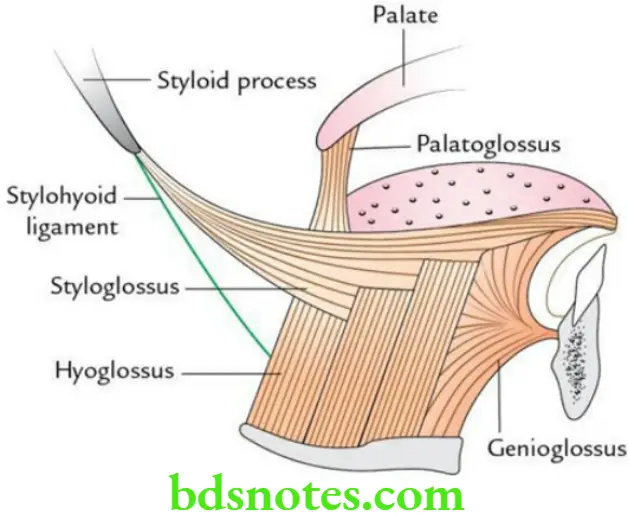
- Genioglossus
- Hyoglossus
- Styloglossus
- Palatoglossus
The origin, insertion, and actions of extrinsic muscles.
Origin, Insertion, and Actions of Extrinsic Muscles of the Tongue
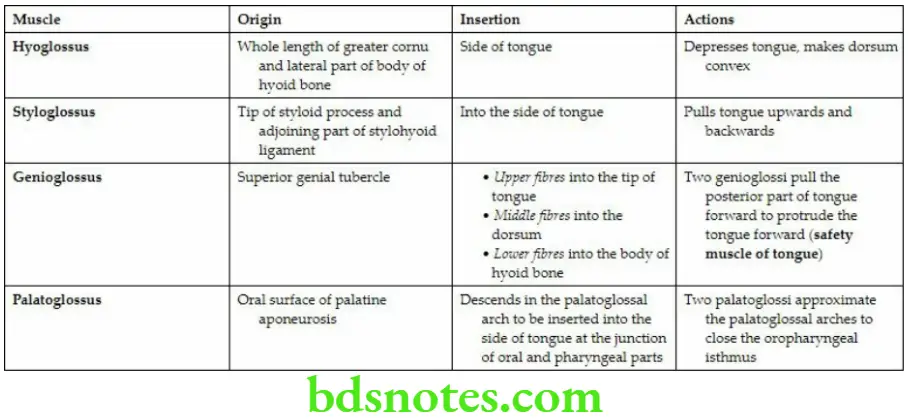
The origin and insertion of extrinsic muscles of the tongue.
Nerve supply
Motor Supply: All the intrinsic and extrinsic muscles of the tongue are supplied by the hypoglossal nerve, except palatoglossus which is supplied by the cranial root of accessory nerve via pharyngeal plexus.
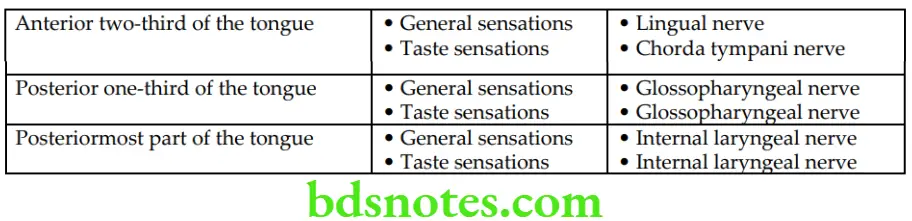
Sensory supply:
Blood supply
- The lingual artery (chief artery of the tongue), a branch of the external carotid artery supplies the oral part of the tongue.
- Tonsillar and ascending palatine arteries, branches of the facial artery supply the pharyngeal part of the tongue.
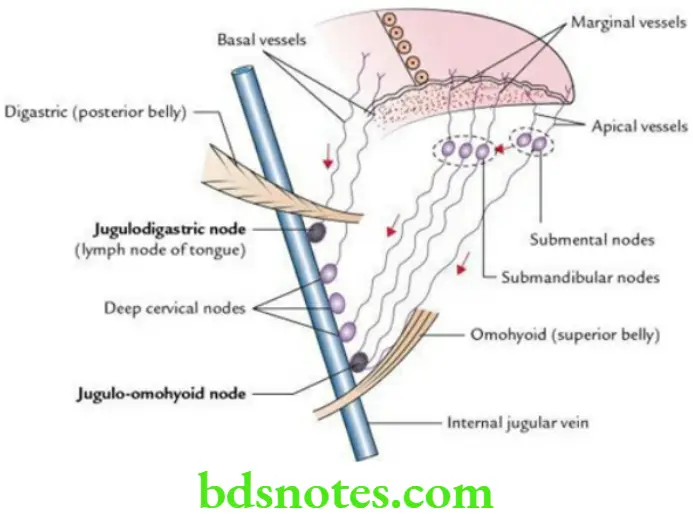
Lymphatic drainage The lymph from the tongue is drained by the following three sets of lymph vessels: marginal, central, and posterior.
Marginal Vessels:
- From the tip, drains bilaterally into the submental lymph nodes.
- From the margins and lateral part of the dorsum of the tongue, drains into the submandibular and jugulo-omohyoid lymph nodes.
Central Vessels: From the central region of the dorsum of the anterior two-thirds of the tongue descends between genioglossi muscles and drains bilaterally into the submandibular lymph nodes.
Posterior Vessels: From the posterior one-third of the tongue drains bilaterally into the deep cervical lymph nodes, principally into the jugulodigastric lymph node.
Applied anatomy
- Injury of the hypoglossal nerve causes paralysis of muscles of the tongue on the side of the lesion; hence, the protruded tongue deviates to the same side (i.e. the side of injury) due to unopposed action of muscles on the healthy side.
- In an unconscious patient, the tongue may fall backward into the oropharynx and obstruct the air passage to cause choking. This can be prevented by turning the head to one side and pulling the mandible forward.
- Carcinoma of the tongue most commonly occurs along the margin of the tongue. Cancer in the posterior one-third of the tongue has a bad prognosis because of bilateral lymphatic drainage.
Leave a Reply