• Skip to main content
  • Skip to secondary menu
  • Skip to primary sidebar
  • About Us
  • Terms of Use
  • Privacy Policy
  • Disclaimer
  • Contact Us
  • Sitemap

BDS Notes

BDS notes, Question and Answers

  • Public Health Dentistry
  • Periodontics
  • Pharmacology
  • Pathology
  • Orthodontics
    • Anchorage In Orthodontics
    • Mandibular Growth, Functional Matrix
    • Retention and Relapse
  • General Surgery
    • Cysts: Types, Causes, Symptoms
    • Maxillofacial Fractures, Disorders, and Treatments
    • Lymphatic Disorders
    • Neurological and Facial Disorders
  • Temporal And Infratemporal Regions
    • Spinal and Neuroanatomy
  • Dental Materials
    • Dental Amalgam
Home » Papilloma

Papilloma

February 8, 2025 by Sainavle Leave a Comment

Papilloma

Papilloma is the benign proliferation of stratified squamous epithelium which result in papillary and verruciform mass.

Papilloma Etiology

Papilloma is caused by human papilloma virus. Viral subtypes 6 and 11 are identified in 50% of oral papillomas.

papilloma

Papilloma Mode Of Transmission

Exact mode of transmission is unknown but transmission is by sexual and non­sexual person to person contact, contaminated objects, saliva or breast milk.

“Importance Of Early Detection Of Papilloma”

Papilloma Clinical Features

  • Papilloma can be diagnosed at any stage but more commonly it is seen in persons of 30 to 50 years of age.
  • Papilloma occurs more commonly on tongue, lip and soft palate but it can involve any of the surface.
  • Papilloma is a soft, painless usually pedunculated, exophytic nodule with numerous figer like projections which impart cauliflwer or wartlike appearance.
  • Lesion can be white, slightly red or normal in color depend on surface keratinization.
  • Papilloma remains solitary and enlarges to the maximum size of 0.5 cm but lesions of 3 cm are also reported.

“Risk Factors For Developing Papilloma”

oral papilloma

Papilloma Histopathology

  • Papilloma is characterized by proliferation of keratinized stratifid squamous epithelium which is arranged in figer like projections along with the fibrovascular cores.
  • Its hallmark feature is proliferation of spinous cells in papillary pattrn.
  • Connective tissue core can show inflammatory changes.
    Presence of chronic inflammatory cells can be variably noted in connective tissue.
  • Koilocytes, i.e. virus altered epithelial clear cells with small dark or pyknotic nuclei with perinuclear clear spaces are sometimes seen in prickle cell layer.

“Understanding The Role Of Hpv In Causing Papilloma”
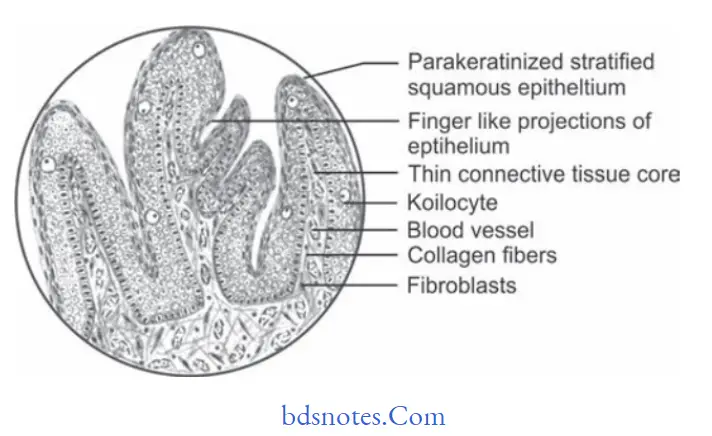
Benign and malignant tumors of Oral cavity Papilloma (H and E Stain)

Papilloma Treatment

Surgical excision should be done including the base of lesion.

Filed Under: Oral Pathology

Reader Interactions

Leave a Reply Cancel reply

Your email address will not be published. Required fields are marked *

Primary Sidebar

Recent Posts

  • Branchial Cleft Cyst: Background, Pathophysiology, Etiology
  • Maxillary Nerve: Origin, Course, And Branches
  • The Father Of Anatomy And A Great Anatomist Herophilus
  • Bone Structure – Anatomy
  • The External Carotid Artery: Anatomy, Branches, And Functions
  • Occipitofrontalis Muscle
  • Superficial Temporal Artery
  • Platysma Muscle
  • Cartilage
  • Cauda Equina And Conus Medullaris Syndromes
  • Subcutaneous Injections And Device Management
  • Types Of Circulation: Pulmonary, Systemic, And Portal
  • Structure Of Skeletal Muscle
  • Elastic Cartilage
  • Cellular Organelles And Structure
  • The Golgi Apparatus – The Cell
  • The Cytoplasmic Inclusions Of Certain Plant Cells
  • Dental Abscess
  • Laser Surgery
  • Our Facial Muscles And Their Functions

Copyright © 2026 · Magazine Pro on Genesis Framework · WordPress · Log in