Polysulfides
“What are polysulfide impression materials? A detailed question and answers guide”
This was the first elastomeric impression material to be introduced (1950). It is also known as Mercaptan or Thiokol. Interestingly, they were first developed as an industrial sealant for gaps between sectional concrete structures.
Polysulfides Supplied As
They are supplied as a two-paste system in collapsible tubes. The base paste is white colored. The accelerator may be brown or gray.
Composition Of Polysulfide Impression Material
Available in three viscosities
- Light bodied
- Medium bodied
- Heavy bodied

“Understanding polysulfide impression materials through FAQs: Composition, properties, and uses explained”
Polysulfides Commercial names
Read And Learn More: Basic Dental Materials Notes
Permlastic (Kerr)
Coe-flex Lead dioxide system
Omni flex Copper hydroxide system

“Importance of studying polysulfide impression materials for dental professionals: Questions explained”
Polysulfides Composition Base paste

“Role of tear strength in capturing accurate impressions: Questions answered”
Polysulfides Reactor paste

“Common challenges in mastering polysulfide knowledge effectively: FAQs provided”
Tray adhesive The adhesive cement should be compatible with the polysulfide impression material. Butyl rubber or styrene/acrylonitrile dissolved in a volatile solvent, such as chloroform or a ketone is used with polysulfide.
Polysulfides Chemistry And Setting Reactions
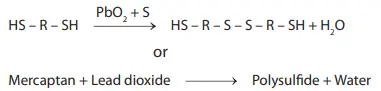
When the base and accelerator pastes are mixed, it undergoes a chemical reaction, whereby the liquid polymer sets to form a solid, but highly elastic and flexible rubber like material.
The lead dioxide reacts with the polysulfide polymer causing
- Chain lengthening by oxidation of terminal—SH groups
- Cross-linking by oxidation of the pendant—SH groups
The reaction is exothermic with a 3–4 °C rise in temperature. It is accelerated by heat and moisture.
“Factors influencing success with polysulfide selection: Q&A”
As an alternative to lead dioxide, an organic hydroperoxide can be used (e.g. t-butyl hydroperoxide). However, these compounds are volatile and so are dimensionally unstable. The other cross-linking system successfully used are certain complex inorganic hydroxides (e.g. copper).
Uses Of Polysulfide Impression Materials
Polysulfides Properties
- Unpleasant odor and color. It stains linen and is messy to work with.
- These materials are extremely viscous and sticky. Mixing is difficult. However, they exhibit pseudoplasticity, i.e. if sufficient speed and force is used for spatulation, the material will seem easier to handle. The mixing time is 45 seconds.
- It has a long setting time of 12.5 minutes (at 37 °C). In colder climates setting can take as longer. This adds to the patient’s discomfort. Heat and moisture accelerate the setting time (sets faster in the mouth).
- Excellent reproduction of surface detail.
“Steps to explain properties of polysulfide impression materials: Tear strength vs hydrophobicity vs setting time: Q&A guide”
- Dimensional stability The curing shrinkage is high (0.45%) and continues even after setting. It has the highest permanent deformation (3–5%) among the elastomers. Elastic recovery improves with time and so pouring of the model should be delayed by half an hour. Further delay is avoided to minimize curing shrinkage. Loss of the by-product (water) also causes shrinkage.
- It has high tear strength (4000 g/cm).
- It has good flexibility (7%) and low hardness. A 2 mm spacing in the tray is sufficient for making an impression.
- It is hydrophobic so the mouth should be dried thoroughly before making an impression. Care should also be taken while pouring the stone to avoid air pockets.
- It can be electroplated. More with silver than copper.
- The shelf life is good (2 years).
Leave a Reply